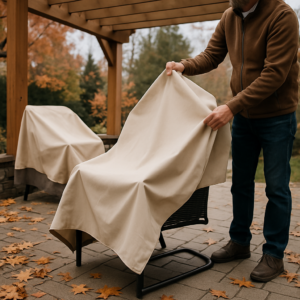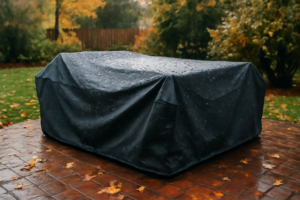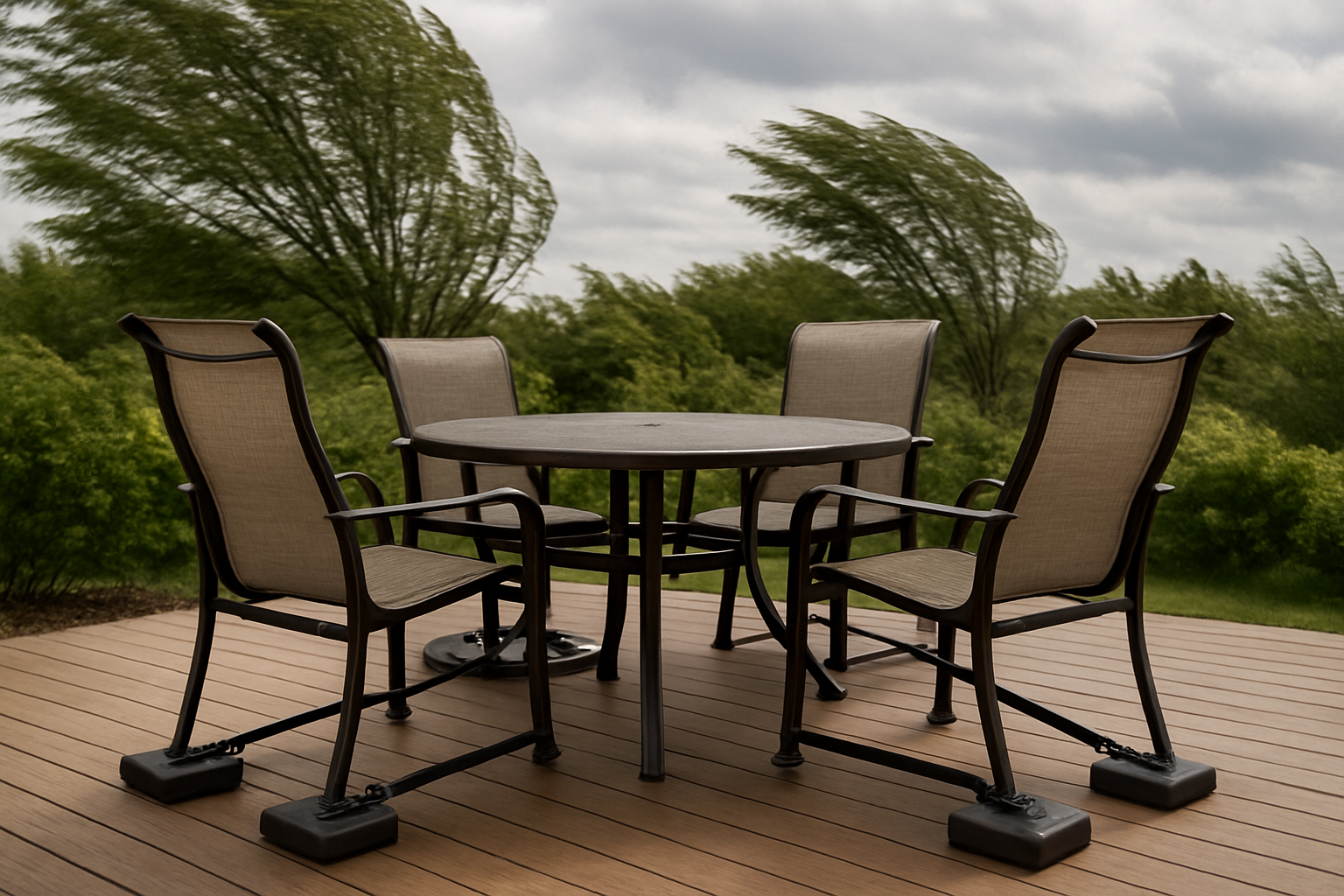
There’s a massive difference between the homeowner who bolts their furniture down before the season starts and the one who figures they’ll deal with it “if a big wind comes”—and I’ve seen enough pool incidents, broken loungers, and dented pavers to tell you exactly which approach saves money and marriages. The second approach always costs more because by the time you’re fishing a chaise lounge out of your neighbor’s deep end or replacing cracked pavers where a table landed, you’re not just buying new furniture or repairs; you’re also buying apologies and potentially lawyers. After years of building patios that survive storms untouched only to watch the stuff on top of them become projectiles, I realized that most people treat furniture anchoring like an optional detail instead of the final, non-negotiable step of any outdoor living space. Here’s what I’ve learned about keeping your patio—and your neighborhood relations—intact when the wind picks up.
I want to save you from my specific brand of embarrassment. So let’s talk about what I did wrong, what I learned, and exactly how I fixed it — products included.
How a Loveseat Ended Up in My Neighbor’s Pool
Here’s the thing about fall storms in our area: they sneak up on you. The forecast said “breezy.” I mentally translated that as “wear a light jacket.” What actually arrived overnight was something closer to a very determined hurricane trying to prove a point. I had done zero preparation because, honestly, it had never occurred to me that my patio furniture needed to be anchored down. It was heavy! It was wicker! It had lived on that deck through two summers without so much as shifting an inch. I figured it had earned the right to stay put.
It had not earned that right.
Somewhere around 3 a.m., based on what Dave later described as “a truly alarming crash followed by a splash,” the loveseat took flight over the six-foot privacy fence and landed right in the deep end of his pool. The throw pillows, to add insult to injury, were scattered decoratively across his lawn like I had hired a staging company. His pool skimmer spent the next hour fishing out what used to be my favorite outdoor cushions. Dave sent me the video. I have watched it approximately forty times because it is genuinely impressive — that loveseat got some air.
After I helped Dave pull everything out, apologized sincerely, and laughed about it for a solid twenty minutes, I drove directly to a coffee shop, opened my laptop, and started researching how to never let this happen again. Here is everything I found.
Securing Patio Furniture from Wind: What Actually Works
The mistake most people make — the mistake I made — is assuming weight alone is enough to keep furniture grounded. It isn’t. Wind doesn’t care how heavy your table is. At high enough speeds, it will catch the underside of a chair, the arm of a loveseat, or the surface of a table umbrella and use basic physics to send your stuff sailing. The solution is to eliminate the gap between “it probably won’t move” and “it definitely cannot move.”
The Anchors That Finally Kept My Patio Set From Becoming Somebody Else’s Problem
After that mortifying afternoon retrieving lounge chairs from my neighbor’s deep end, I realized that wind doesn’t care how well your patio is sealed—it only cares about unsecured weight sitting on top of it. These anchors are the difference between furniture that stays put and an expensive apology.
What works
- The anchor footprint is wide enough to distribute force across the patio surface without gouging sealed concrete or pavers—I’ve used them on everything from finished driveways to decorative stamped work.
- Installation takes five minutes per anchor with just a drill and concrete bit; no special tools or expertise required, which means you’ll actually do it instead of telling yourself you will.
- They handle seasonal wind loads without drift or creep—I’ve left furniture anchored through two full seasons and never had to re-tighten a single bolt.
What doesn’t
- The anchors are visible when furniture isn’t in place—so if your aesthetic is “blank patio,” you’ll need to remove them seasonally, which adds friction to the whole system.
- You need to drill into finished concrete or pavers, and if you’re nervous about cracking your new patio work, that first hole will feel like defacing a museum piece (it’s not—concrete forgives).
I hesitated pulling the trigger on drilling my own sealed patio the first time, convinced I’d somehow ruin months of work with one wrong angle, but four anchor holes later I realized the real risk was never anchoring in the first place. Grab a 4-Pack Strong Outdoor Furniture Deck Anchors and do it before wind does it for you.
About This Article

Written by Marcus Delvecchio. Marcus Delvecchio isn't a licensed contractor — he's a handyman and DIY outdoor landscaper who got obsessed with driveways, patios and pavers after redoing his own place badly enough to want to understand why. Twenty years later he spends his weekends on his own projects and on side jobs for neighbours and friends around the mid-Atlantic, and writes up what actually worked, mistakes included. More about this site.
Scope and limits. Marcus is a homeowner who got obsessive about driveways, not a licensed contractor. Structural repair, drainage changes, and anything requiring a permit should go to a licensed contractor.
Verify this against a primary source
Specifics change, and your situation may differ from the one described here. These are the authorities worth checking directly:
- Concrete Masonry & Hardscapes Association — segmental paver installation standards
- National Asphalt Pavement Association — asphalt placement and maintenance guidance
- Portland Cement Association — concrete durability and jointing