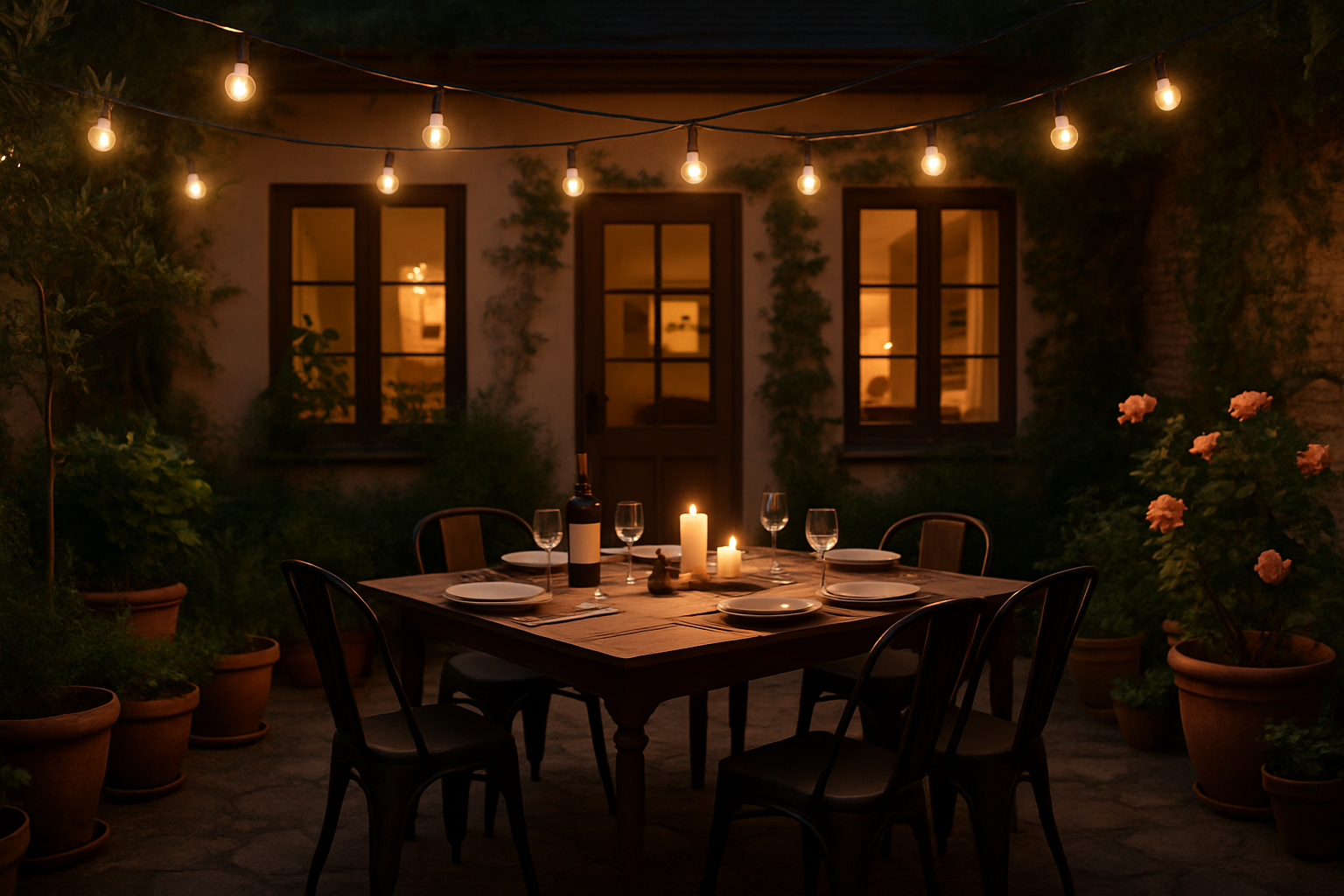
Scope creep is the reason most outdoor projects go over budget — not contractor greed, not material cost spikes. Once the ground opens up, you find what’s actually under there. Broken drainage, unstable base, outdated wiring. I tell every client upfront: whatever you budgeted, add 20% for what we’ll find. Bistro lighting installs are no different — what looks like a simple string-light job on a Saturday afternoon usually surfaces questions about structural anchor points, circuit load, and whether your existing outdoor outlet was ever meant to handle permanent fixtures. I’ve watched plenty of enthusiastic DIYers hit those walls mid-project, and the ones who come out the other side with results that actually last are the ones who understood what they were getting into before they picked up a drill — so everything that follows here comes straight from the trade floor, not a product page.
This post contains affiliate links. As an Amazon Associate, I earn from qualifying purchases. This means I may earn a small commission if you click through and make a purchase, at no extra cost to you. I only recommend products I’ve personally used or thoroughly researched.
How One “Quick” Weekend Project Nearly Ended a Friendship
My friend Carla and I had been talking about transforming my back patio for months. The space had good bones — a decent concrete slab, a pergola frame, some container plants — but it felt flat and lifeless after dark. We’d both been swooning over those warm, glowing café-style lights we kept seeing on Instagram and Pinterest, and we finally committed to a date: second Saturday of October, start at 10 a.m., done by noon. Lunch on the patio. Easy.
Reader, we were not done by noon.
The first problem was that I’d eyeballed my measurements instead of actually measuring. My pergola spans about 14 feet across and 18 feet deep, and I’d bought what I thought was plenty of string light length. Wrong. I also hadn’t accounted for the drape — that gentle, festive swag that makes bistro lights look like bistro lights instead of a sad clothesline. By the time Carla and I had unspooled everything and started mapping out the runs, we were already short, already bickering about whose fault it was, and already thirty minutes behind.
Then came the guide wire situation. I’d assumed I could just clip the lights to my pergola beams and call it a day. Carla — bless her and also briefly curse her — pointed out that without a support wire, the lights would sag unevenly and the weight could stress the sockets over time. She was right. I knew she was right. I did not want to hear it in that moment.
What I Wish I’d Known Before the Bistro Outdoor Lighting Install
Here’s everything I learned the hard way, packaged neatly so you don’t have to white-knuckle your way through it like we did.
Measure Twice (For Real This Time)
Before you buy a single strand, measure your space and then add 20–30% more length to account for the natural drape of the lights. A gentle swag between anchor points looks intentional and beautiful. A tight, straight run looks like you’re drying laundry. Measure the full perimeter if you’re doing a border run, or calculate each individual span if you’re doing a crisscross overhead pattern.
Use a Guide Wire — Always
Carla was right. String lights are not designed to bear their own weight over long spans without support. A stainless steel guide wire runs taut between your anchor points, and your lights drape gently over it. This protects the sockets, keeps everything level, and means your lights will still look gorgeous years from now instead of listing sadly to one side.
Plan Your Power Source First
Know where your outdoor outlet is before you start stringing. The end of your light strand with the plug needs to land close to power. If you plan backward from your outlet, you’ll save yourself a lot of frustrated re-hanging. If you don’t have a conveniently located outdoor outlet, this may be the time to call an electrician — don’t run extension cords permanently across a patio surface.
Anchor Points Matter More Than You Think
Your guide wire needs solid anchor points. Pergola posts, exterior walls with proper hardware, and wooden fence posts all work well. Use eye hooks rated for outdoor use and make sure they’re drilled into structural material, not just siding or trim. Turnbuckles help you tension the wire after installation so you can get that perfect, even line.
What I Used — My Recommended Products
After my chaotic first attempt, I did a lot more research before buying my second strand (yes, I needed a second strand). Here’s what I ended up with and what I’d buy again in a heartbeat.
String Lights
For a larger patio or pergola, the Svater 105FT Commercial Grade Bistro String Lights are hard to beat. They’re ETL listed, use dimmable S14 shatterproof bulbs, and the warm white glow is exactly the soft, golden ambiance you’re picturing. Commercial grade means these hold up through rain, wind, and temperature swings without fading or flickering. The 105-foot length is generous enough for most backyard setups, and the fact that they’re dimmable means you can dial back the brightness for quiet evenings or turn them up for a party.
If you want something a little more compact or have a smaller space like a balcony or gazebo, the 100FT ST38 Shatterproof Edison Bulb String Lights are a beautiful option with a vintage Edison aesthetic. The ST38 bulb shape has a slightly more elongated silhouette that looks stunning from below. Also dimmable and fully waterproof.
For a shorter run — say, a covered porch or a small deck — I love the addlon 48FT LED Outdoor String Lights. These are ETL listed, commercially weatherproofed, and the vintage shatterproof bulbs give off that warm, honeyed glow that makes outdoor evenings feel like something out of a Tuscan courtyard. Great quality for a very reasonable price.
Guide Wire and Hanging Hardware
This is the part I originally skipped. Don’t skip it. The Newleray String Light Hanging Kit includes 164 feet of nylon-coated stainless steel 304 wire rope along with all the hardware you need to install it properly. The nylon coating protects both the wire and your lights from abrasion, and the kit is comprehensive enough that you won’t be making a second hardware store run mid-project (unlike some people I know — me, I’m talking about me).