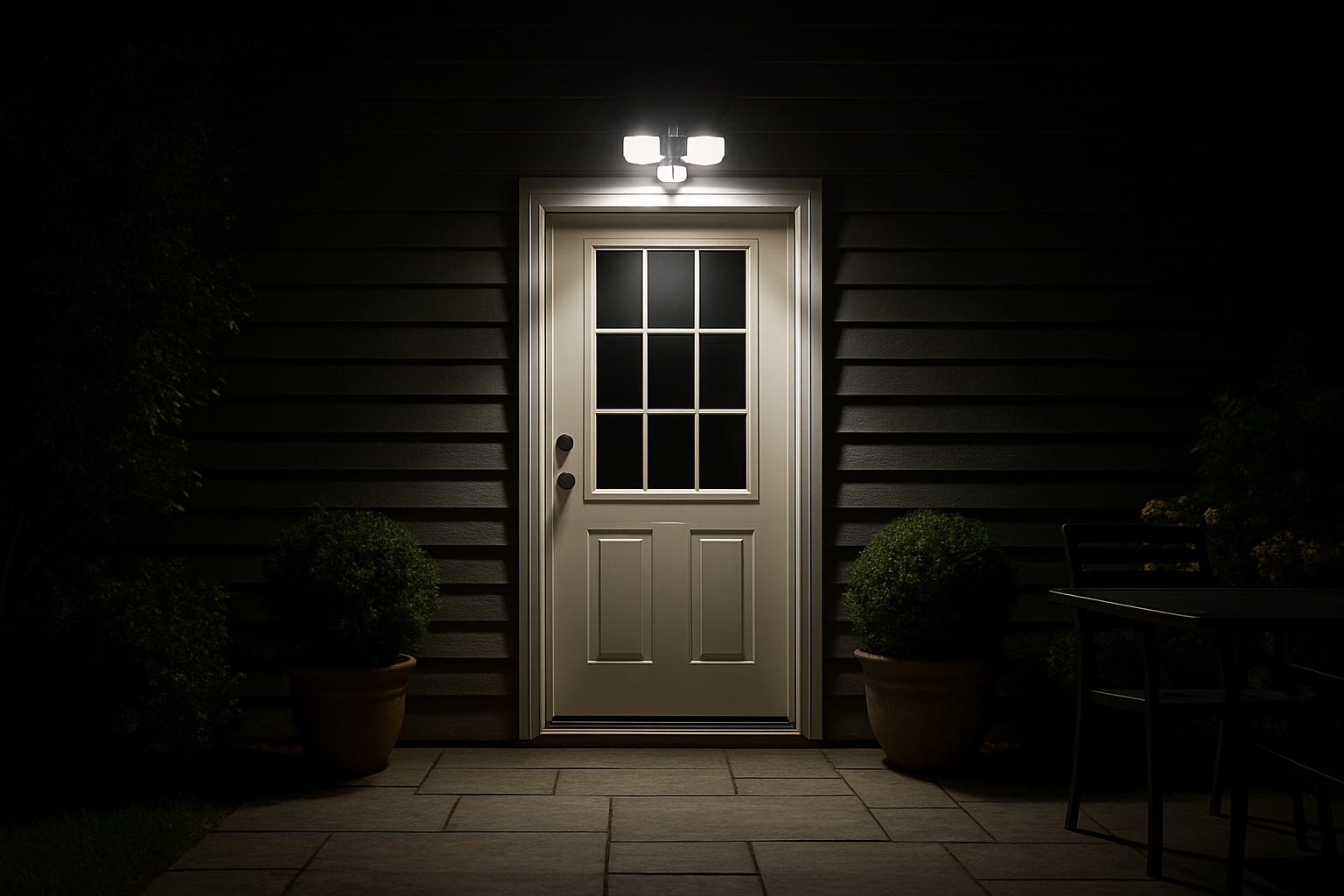
- Height matters: Mount between 6 and 10 feet high. Too low and the detection cone is narrow and easy to duck under. Too high and sensitivity drops for close-range movement.
- Angle the sensor correctly: PIR sensors detect movement crossing their field of view better than movement coming straight toward them. Position so people walk across the detection zone, not directly at it.
- Cover all entry points: Think like someone who shouldn’t be there. Front door, back door, side gate, detached garage — these are your priority zones. Don’t just protect the front and leave the back dark.
- Avoid false triggers: Don’t aim sensors directly at the street, at a neighbor’s busy driveway, or near large trees with branches that move in the wind. You’ll be chasing phantom alerts all night.
- Test before you commit: After installation, walk the yard at night and watch where the light activates. Adjust sensitivity and aim before calling it done.
- Height matters: Mount between 6 and 10 feet high. Too low and the detection cone is narrow and easy to duck under. Too high and sensitivity drops for close-range movement.
- Angle the sensor correctly: PIR sensors detect movement crossing their field of view better than movement coming straight toward them. Position so people walk across the detection zone, not directly at it.
- Cover all entry points: Think like someone who shouldn’t be there. Front door, back door, side gate, detached garage — these are your priority zones. Don’t just protect the front and leave the back dark.
- Avoid false triggers: Don’t aim sensors directly at the street, at a neighbor’s busy driveway, or near large trees with branches that move in the wind. You’ll be chasing phantom alerts all night.
- Test before you commit: After installation, walk the yard at night and watch where the light activates. Adjust sensitivity and aim before calling it done.
The shift toward native planting has been the best thing to happen to residential landscaping in a generation — not because of trends, but because properties that work with their local ecosystem stop fighting their environment. Less irrigation, less replacement, less maintenance. I’ve redesigned dozens of yards to native palettes and the results consistently outperform traditional plantings by year three. What I’ve also noticed, project after project, is that once clients invest in a planting plan that finally feels right, they start paying attention to everything else in the outdoor space — the deck, the furniture, the lighting — because the yard is suddenly worth spending time in after dark. That’s exactly how motion sensor lighting moves from an afterthought to a genuine priority: not as a security checkbox, but as the layer that makes a well-designed outdoor space actually usable at night, and as I’ve seen on more than a few job sites, a surprisingly effective deterrent when it matters most.
This post contains affiliate links. As an Amazon Associate, I earn from qualifying purchases. If you click a product link and make a purchase, I may earn a small commission at no extra cost to you. I only recommend products I’ve genuinely researched or used myself.
I had installed the lights just that afternoon, proud of myself, feeling very capable and homeowner-y. What I had failed to account for was that I, myself, would become the first suspicious character they detected. Apparently, sneaking to the kitchen at midnight qualifies as “motion” worthy of full tactical illumination. Who knew?
But here’s the thing — and this is where the story gets a lot less funny and a lot more worth telling — about three weeks later, those same lights did exactly what I actually installed them to do. But I’m getting ahead of myself. Let’s talk about how to set these things up the right way, so you can protect your home without becoming the first casualty of your own security system.
Why Outdoor Motion Sensor Lights Are Worth Every Penny
Before we get into specs and placement, let me make the case simply: motion-activated security lighting is one of the highest-return outdoor upgrades you can make. Studies consistently show that well-lit properties are significantly less attractive targets for break-ins. Burglars rely on darkness and surprise. Take those away, and you take away their confidence.
Beyond security, these lights are genuinely practical. Coming home late and fumbling for your keys in the dark? Light. Taking the dog out at 11 p.m.? Light. Hearing a noise on the back porch and needing to decide whether it’s a raccoon or something worse? Very bright, slightly terrifying light. They work hard, they’re energy efficient, and most modern LED options are built to handle years of rain, wind, and whatever weather your region throws at them.
Choosing the Right Light for Your Space
Not all motion sensor lights are created equal, and the biggest mistake people make is buying a light that’s either wildly underpowered for the space or so aggressive it lights up the neighbor’s bedroom. Here’s how to match the light to the location.
For Smaller Areas: Entryways, Side Gates, and Porches
If you’re covering a focused zone — a front door, a side yard entry, or a single-car garage — you don’t need industrial-grade output. Something in the 2,000–4,000 lumen range will do the job cleanly without blasting your entire street. The LEPOWER 30W LED Security Light is a solid entry-level option here. It’s a 3,200-lumen, dual-head hardwire fixture with IP65 waterproofing and a crisp 5500K daylight output. Easy to install, dependable, and won’t blind your mail carrier.
For Mid-Range Coverage: Decks, Patios, and Driveways
This is the sweet spot for most homeowners. You want solid coverage without overkill, and ideally a light with multiple modes so you can customize behavior — motion-only, dusk-to-dawn, or a combination. The Philips 44W LED Security Light is a fantastic choice in this category. It pumps out 4,200 lumens with a 5000K daylight color temperature, offers four operating modes, and has a built-in PIR motion sensor along with dusk-to-dawn capability. The Philips name also means you’re getting a fixture engineered for longevity. This is very close to what I installed on my back patio — the one that caught me with the Oreos.
If you want a step up in output for a larger patio or a wide driveway, the LUTEC 72W 3-Head Motion Sensor Light delivers an impressive 7,500 lumens across three adjustable heads. The heads pivot independently, which is a genuine advantage when you’re trying to cover a large L-shaped area or a deck with multiple access points. IP65 rated, dusk-to-dawn capable, and finished in a clean matte black that looks sharp against most siding.
For Large or High-Priority Coverage: Backyards, Workshops, and Large Garages
If you’ve got a big open yard, a detached garage, or an area you’re genuinely concerned about, go with maximum output. The LUTEC 80W 4-Head Flood Light is a beast in the best way — 9,000 lumens, four independently adjustable heads, IP65 waterproofing, and hardwire installation that means it’s not going anywhere. For wide open spaces, the Onforu 75W 3-Head Flood Light is another excellent option at 7,000 lumens with a slightly cooler 6500K output that produces that bright, clear daylight quality ideal for security applications.
Placement Tips That Actually Make a Difference
The hardware is only half of it. Where and how you mount your outdoor motion sensor lights determines whether they’re genuinely effective or just decorative anxiety.