This post contains affiliate links. As an Amazon Associate I earn from qualifying purchases at no extra cost to you.
The most honest thing I can tell any homeowner watching my crew work is this: the material you see is about 30% of the job. The other 70% is what we did to the ground before we ever touched a paver, a board, or a post. Most DIY projects fail at that invisible 70%. Pond builds are no different — and in some ways they punish skipped steps faster than anything else we install, because water finds every shortcut you took. So when I walk through the choice between a flexible pond liner and a preformed pond shell, I’m not just comparing products; I’m comparing how each one responds to real ground conditions, real mistakes, and real homeowners who want something that holds up past the first spring thaw.
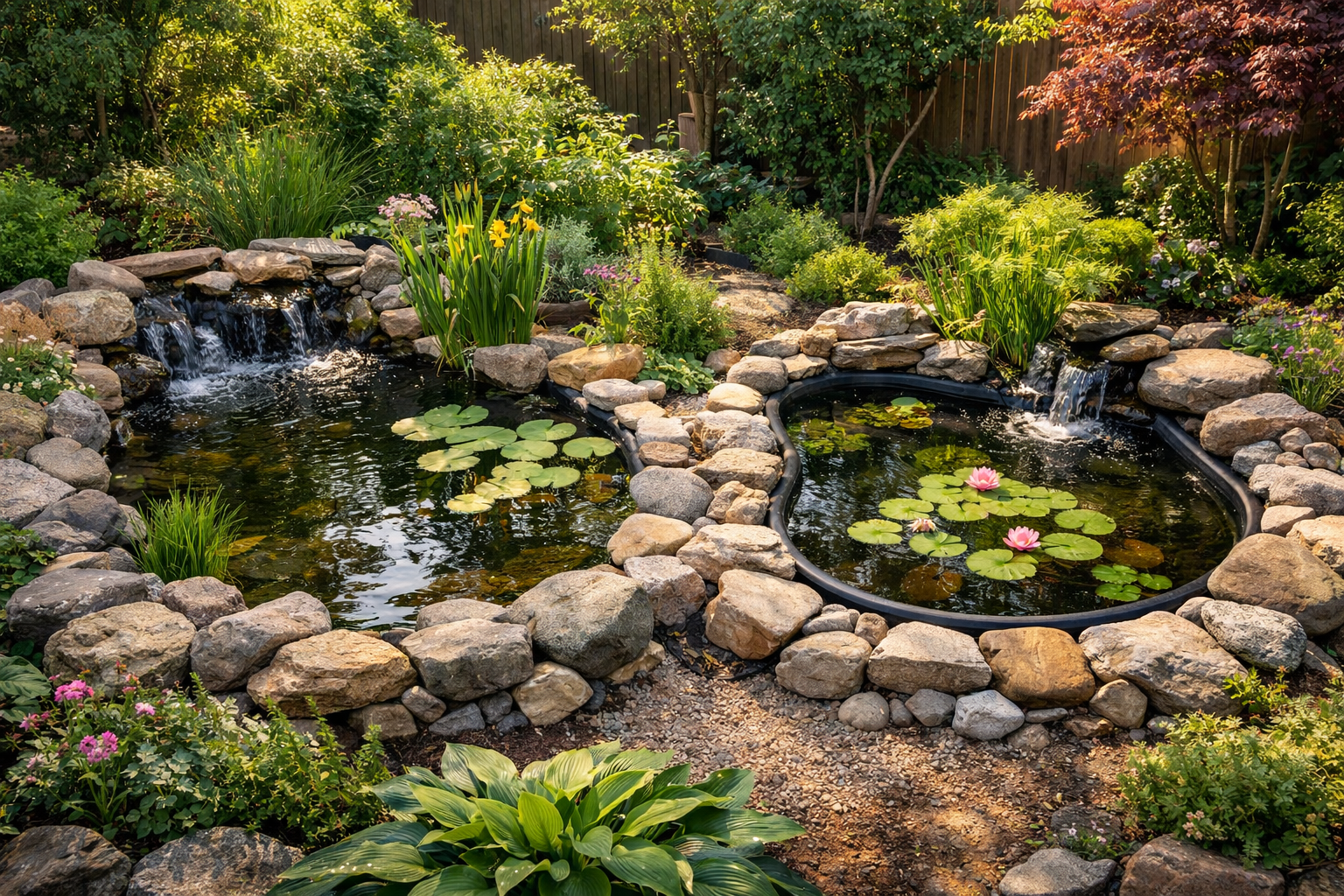
What Is the Difference Between a Pond Liner and a Preformed Pond Shell?
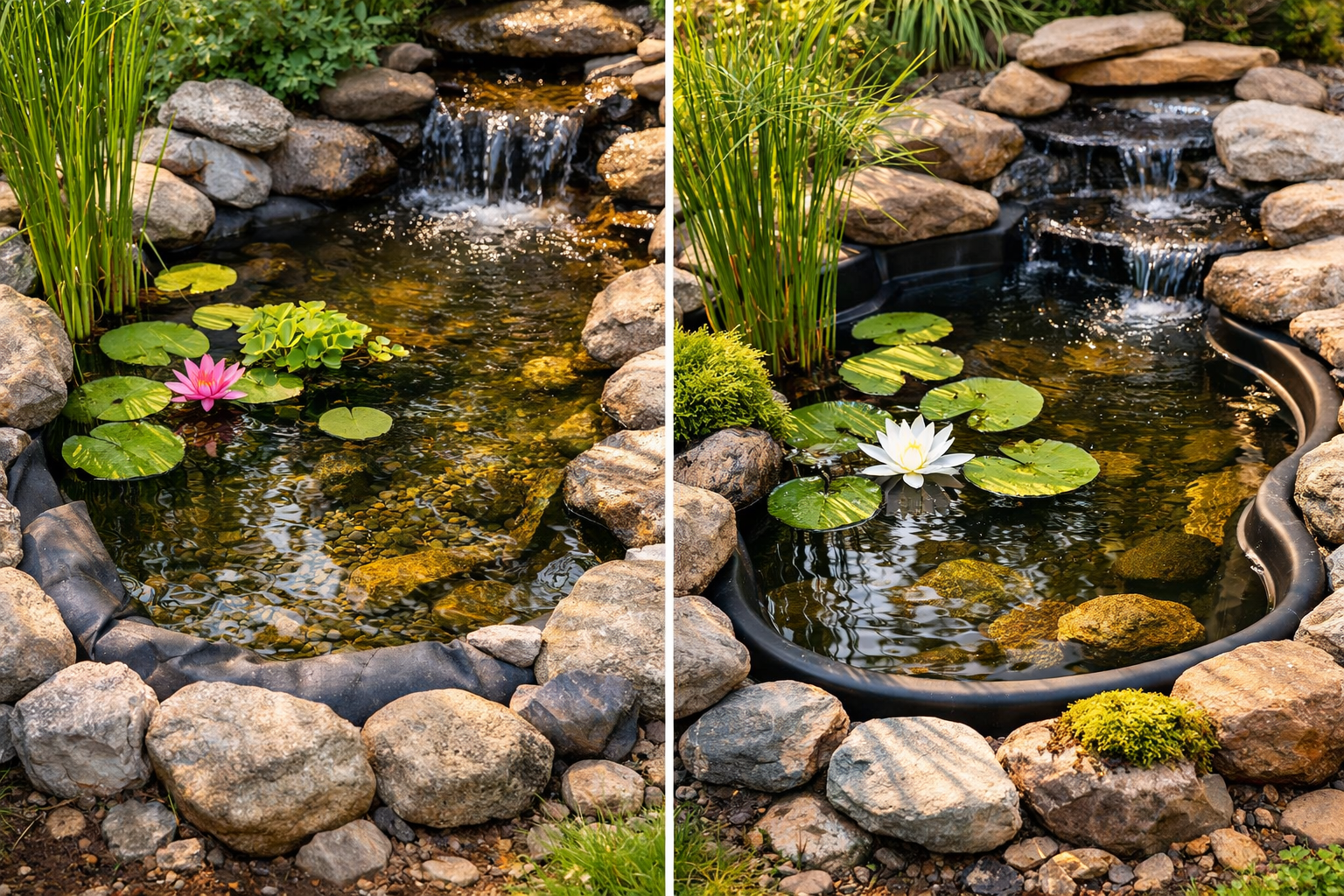
Before we get into the pros and cons, let me quickly break down what we are actually talking about. A pond liner is a flexible sheet — usually made from EPDM rubber or PVC — that you lay into a hand-dug hole of whatever shape and size you want. You fold it, tuck it, and anchor the edges, and the water does the rest of the work holding it in place. A preformed pond shell, on the other hand, is a rigid plastic or fiberglass basin that already has a fixed shape. You dig a hole to match its contours, set it in, level it, and fill it up. Simple in theory. Occasionally maddening in practice.
Both options are genuinely DIY-friendly, and both can produce a beautiful, long-lasting water feature. The right choice depends on your yard, your budget, your timeline, and honestly, how patient you are on a warm weekend afternoon.
The Case for a Flexible Pond Liner
My first pond was built using a flexible EPDM liner, and I will admit — I underestimated how enjoyable the design process would be. Because you are not locked into a predetermined shape, you can make your pond as long, wide, shallow, or deep as your space allows. I ended up with a gently curved, kidney-shaped pond that fit perfectly against the back garden wall. It felt like drawing freehand versus tracing a stencil.
Flexible liners also scale beautifully. If you want something in the range of 8 by 11 feet, a kit like the Aquascape DIY Backyard Pond Kit 8 x 11 feet takes a lot of the guesswork out of the process. It comes with a pump, skimmer, and filter already included, which saved me from the classic beginner mistake of buying undersized equipment. For anyone who wants to add a water feature element, the Aquascape DIY Backyard Waterfall Kit pairs seamlessly with liner-based builds and adds that satisfying sound of running water that makes a backyard feel like a completely different place.
Here are the main advantages I noticed with a flexible liner:
- Complete freedom over shape, depth, and size
- Easier to transport — it rolls up flat
- Can accommodate planting shelves at custom depths
- Repairs are straightforward with a patch kit
- Generally more cost-effective for larger ponds
On the repair point — I did eventually get a small puncture near a sharp stone I had missed during excavation. Fixing it was far less dramatic than I expected. A product like the ToLanbbt 2PCS Pond Liner Repair Patch makes short work of small leaks. These self-adhesive EPDM patches peel and stick directly onto the liner and create a solid waterproof seal. I keep a pack in the shed permanently now. If you are dealing with a seam rather than a puncture, the Pond Guy EPDM Liner Seam Kit is the more heavy-duty solution for joining liner sections cleanly.
The honest downside? Folding and tucking a large liner into a freeform hole is genuinely awkward, especially if you are working alone. The liner on my first pond had about four extra inches of material bunched up in one corner that I spent an embarrassing amount of time trying to hide with rocks.
The Case for a Preformed Pond Shell
My second pond used a preformed rigid shell, and I went into it thinking it would be the easier option. In some ways it absolutely was. There is no folding, no tucking, no wondering whether the liner is thick enough. The shell holds its shape, the edges are already finished, and the planting shelves are built right in. Once it is level and settled, it looks tidy and intentional straight away.
The part I did not anticipate? Getting the hole to match the shell is surprisingly tricky. You would think digging to the outline of a fixed shape would be simple, but preformed shells have curved undersides and varying depths in different zones. My hole was half an inch off level on one side, which meant I spent a good hour adding and removing sand until everything sat correctly. If you rush this step, you will end up with an uneven water line that drives you quietly mad every time you look at it.
That said, here is where preformed shells genuinely shine:
- Extremely durable — rigid fiberglass shells can last 50 years or more
- Faster installation once the hole is correctly shaped
- Built-in planting shelves at standardized depths
- No risk of punctures from roots or sharp stones
- Great for smaller, tidier garden spaces
If you want to start small and see how you get on with a water feature before committing to a larger excavation, the Aquascape Micro Pond Kit with FREE LED 3-Light Kit is a genuinely lovely starter option. It is compact, comes with lighting included, and looks polished in a smaller garden or courtyard setting.
The main limitation of a preformed shell is the one you probably already guessed — you get what you get in terms of shape and size. If you want something wider, deeper, or more organically shaped, no amount of creative digging is going to change the footprint of a rigid basin. They also tend to become less practical for anything over about 500 gallons, where liner builds become much more economical.
Adding Movement and Life to Either Option
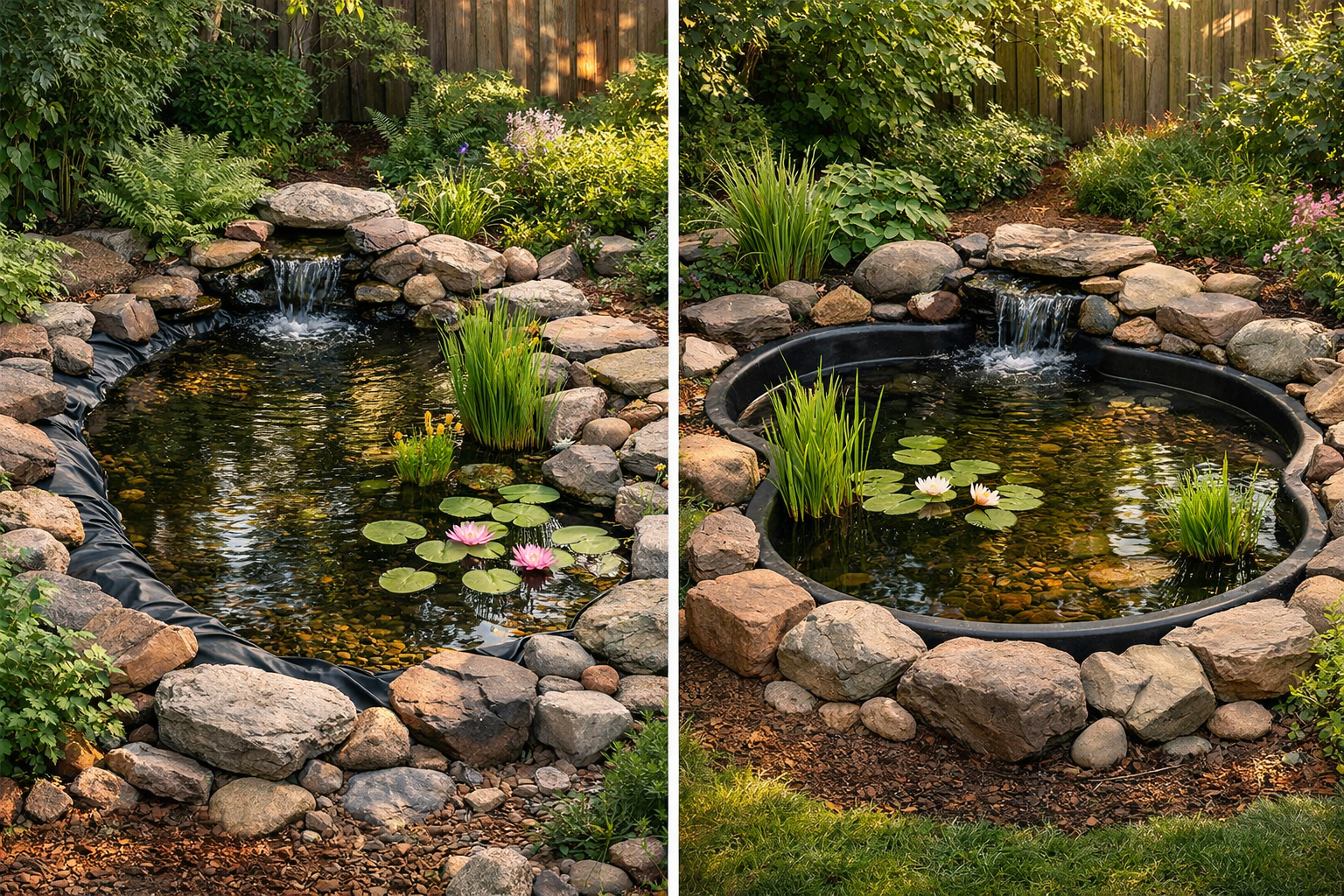
One thing that transformed both of my ponds was adding a simple water movement element — not necessarily a full waterfall, but enough surface agitation to oxygenate the water and bring in wildlife. If you are building a smaller pond and want a low-maintenance solution, solar-powered fountains are brilliant. No wiring, no running costs, and they look lovely in the sunlight.
A few options I have tried or seen work well: the Solar Fountain Water Pump for Bird Bath and Pond is an affordable 1.5W unit that works well in smaller preformed shells or as a supplementary feature in a larger liner pond. The Mademax 1W Solar Bird Bath Fountain Pump is similarly priced and free-standing, which means no fiddling with placement on a liner surface. For something that includes tubing and a bit more flexibility in setup, the Biling Solar Fountain for Bird Bath and Small Pond comes with 4 feet of tubing and works particularly well in preformed shells where you want to direct the flow toward a planted shelf.
Even a modest fountain spray makes a noticeable difference to how inviting the pond feels — and birds absolutely lose their minds for it in summer.
Pond Liner vs Preformed Pond Shell: My Final Recommendation
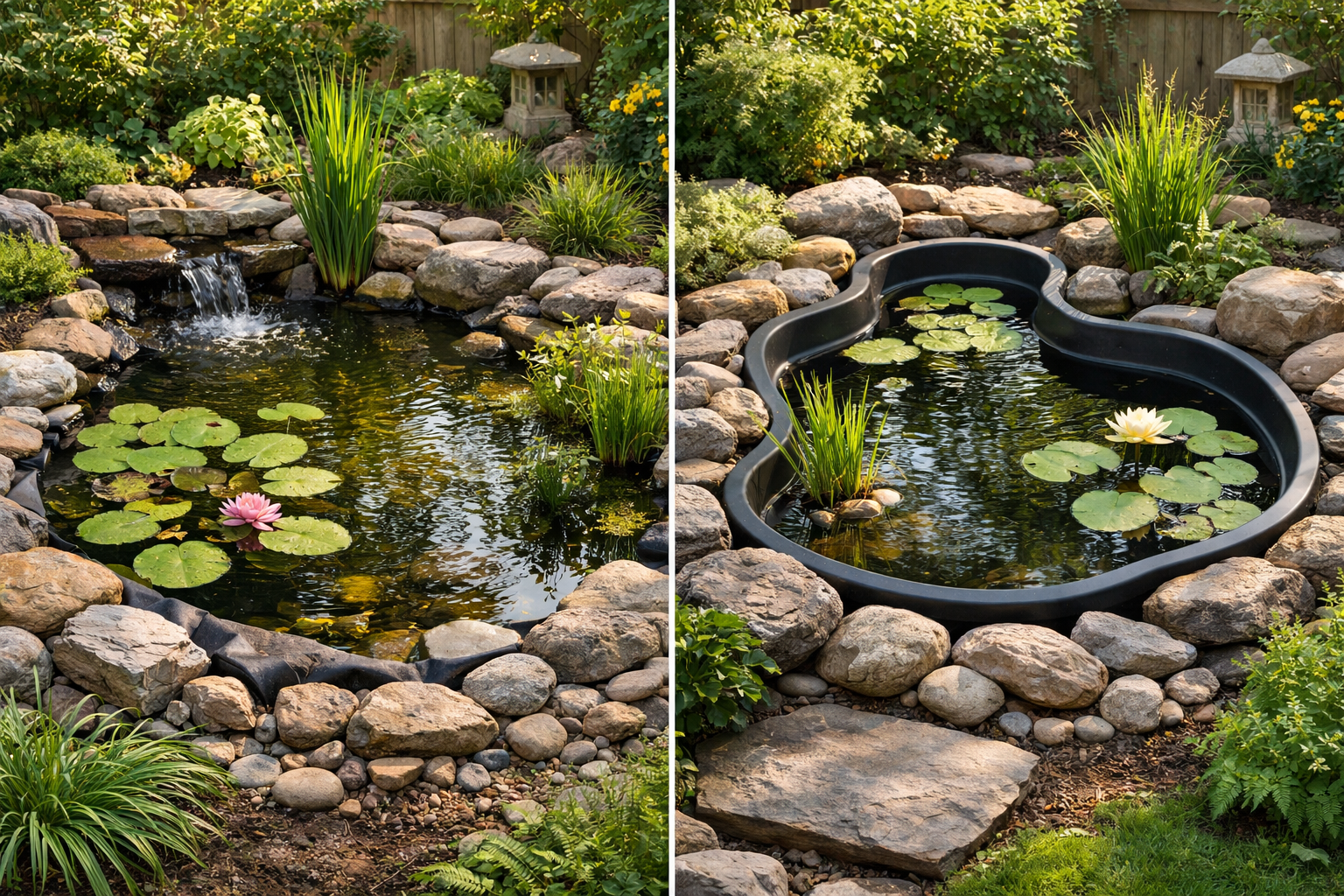
After building one of each, here is how I would break it down for most DIY backyard builders:
Choose a flexible pond liner if you want creative control over shape and size, plan to build something larger than roughly 100 gallons, or enjoy the process of designing a feature that feels truly bespoke to your yard. The Aquascape DIY Backyard Pond Kit is a fantastic starting point that bundles everything you need without the guesswork. Just budget extra time for that final folding stage, and keep some repair patches on hand for peace of mind.
Choose a preformed pond shell if you want a quick, clean installation, are working with a compact garden space, or simply want a reliable structure that will never spring a surprise leak. Pair it with the Aquascape Micro Pond Kit for a complete, low-stress setup that looks great from day one.
Honestly? Neither choice is wrong. Both of my ponds have given me enormous amounts of pleasure, attracted frogs, dragonflies, and birds I had never seen in the garden before, and made me far more comfortable spending time outside. The best pond is the one you actually build — so pick the option that fits your space, your weekend schedule, and your tolerance for the occasional muddy detour.
Have you already built a pond, or are you just starting to plan one? Drop a comment below and tell me which route you are leaning toward — I would genuinely love to hear about your project.