Most people think the gas grill versus pellet smoker choice comes down to taste preference and budget—pick whichever fits your palate and your wallet, and you’re done. That’s the myth I’ve watched cost homeowners thousands in rework fees, because the equipment you choose dictates everything downstream: your gas line routing, your countertop materials, your ventilation requirements, even whether your pergola roof needs structural reinforcement. I’ve spent eighteen years watching outdoor kitchens get redesigned mid-build because someone selected cooking equipment first and only later realized it demanded a completely different infrastructure setup than what was already framed out. The truth is, this decision has to drive your entire outdoor space design—not the other way around.
I’ve been grilling in my backyard for about eight years. I thought I was pretty good at it. My gas grill and I had a solid relationship — reliable, fast, predictable. But every time I scrolled through my feed and saw those gorgeous smoke rings on a brisket, or caught a whiff of wood-smoked ribs at a neighbor’s place, I felt like I was missing something. So I did what any reasonable person does when they can’t decide between two things: I bought both. And then I invited a crowd over to witness my chaos firsthand.
Gas Grill vs Pellet Smoker: What’s Actually the Difference?
Before I walk you through my spectacular near-disaster, let me give you the practical breakdown — because if you’re here, you’re probably trying to make this same decision without the added pressure of a dozen hungry people watching you fumble with an instruction manual.
A gas grill runs on propane or natural gas, ignites instantly, and gets hot fast. We’re talking ready-to-cook in ten minutes or less. It’s the weeknight workhorse. Burgers, chicken thighs, corn on the cob — done and done. The flavor is clean, the control is immediate, and cleanup is straightforward. If you need to feed people quickly and consistently, a gas grill is hard to beat.
A pellet smoker, on the other hand, burns compressed wood pellets to generate both heat and smoke. The flavor payoff is enormous — you get that authentic wood-smoked depth that gas simply can’t replicate. Modern pellet grills use digital controllers and even WiFi connectivity to hold temperatures with impressive precision. The tradeoff? They take longer to heat up, and low-and-slow cooking means you need to plan ahead. That thing about planning ahead is what bit me on that Saturday.
The Day I Tried to Out-Cook Myself
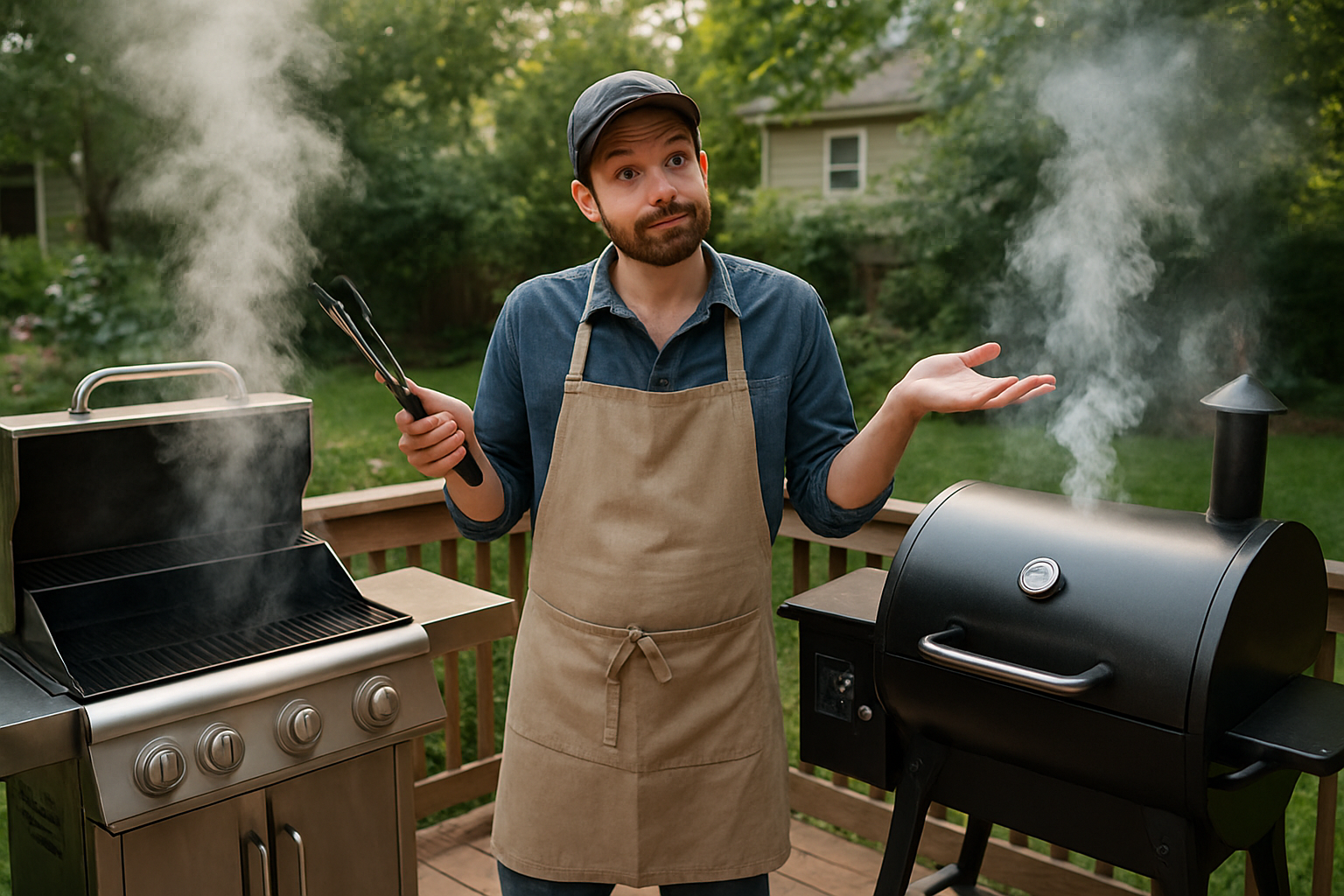
Back to my story. I’d loaded the hopper with pellets, set the temperature on the app — yes, the app — and confidently walked inside to season my pork shoulder. Forty minutes later I came back out to check on the preheat and found the smoker sitting cold. Completely cold. I had forgotten to plug it in. Not only that, but in my rush to fix the problem, I knocked over the entire bag of pellets I’d left perched on the edge of the patio table. Two-thirds of a twenty-pound bag, scattered across my newly sealed pavers like the world’s most depressing confetti.
I stood there for a solid thirty seconds just staring at it. Then I called my neighbor Dave, who has owned a pellet smoker for three years, and asked if I could borrow his gas grill as backup. He did not let me live this down. He still hasn’t.
Here’s what saved the day: I fired up my gas grill to handle the burgers and sausages for the guests who were arriving soon, while I got the pellet smoker properly started for the pork shoulder. It cooked low and slow over the next several hours while everyone ate. By the time dessert was done, so was the pork — and when I pulled it apart and set it out, it was the best thing I have ever made in my life. Smoky, tender, absolutely worth every bit of the earlier embarrassment.
Choosing the Right Setup for Your Backyard
Here’s the honest truth I arrived at after that day: gas grills and pellet smokers aren’t really competitors. They’re teammates. But if you’re working with a budget or limited patio space and need to pick one, here’s how to think through it.
Go with a gas grill if:
- You cook on weeknights and need meals ready in under 30 minutes
- You’re feeding a crowd with straightforward proteins and veggies
- You want something your whole family can operate without a learning curve
- Your outdoor kitchen already has a propane or natural gas hookup
Go with a pellet smoker if:
- You love the idea of set-it-and-forget-it cooking on weekends
- You want restaurant-quality smoke flavor at home
- You’re into brisket, ribs, pork shoulder, or smoked chicken
- You enjoy the process of cooking as much as the eating
One practical note: if you’re placing either unit on a patio or deck, make sure your surface can handle the heat. Keep a clearance of at least three feet from any structure, fence, or overhead covering. A fire-resistant mat under your smoker is a smart addition, especially on composite or wood decks. And always check local codes if you’re building a permanent outdoor kitchen setup around your grill.
My Recommended Products for Gas Grills and Pellet Smokers
Whether you’re landing on one side of the gas grill vs pellet smoker debate or going full dual-setup like me, here are the products I’d point you toward.
The Pellet Smoker That Made Me Stop Second-Guessing My Outdoor Kitchen Layout
When you commit to a cooking method, you’re committing to everything downstream — the countertop depth, the gas or electrical line routing, the concrete pad dimensions, the drainage slope. Choosing a pellet smoker over gas forces you to think about infrastructure differently, and the recteq Patio Legend 400 is built for contractors and serious DIYers who need that decision to stick.
What works
- Footprint is compact and predictable — no sprawling gas lines or venting complications, which means your concrete pad dimensions are locked in from day one instead of shifting mid-project.
- Hopper capacity means you’re not refilling mid-cook, so your outdoor kitchen design can breathe without tight supply-line routing or storage niches that eat into counter space.
- Temperature holds steady without adjustment, which actually drives cleaner countertop placement decisions — no heat-radiating zones that force materials or spacing compromises.
What doesn’t
- Requires 110V electrical hookup, which means you’re planning permanent infrastructure instead of a flexible gas-only setup — that’s a bigger concrete and conduit commitment upfront.
- Pellet storage and weather protection becomes part of your outdoor design, not an afterthought — you can’t just tuck bags anywhere without thinking about moisture and your overall patio layout.
I almost talked myself out of the electrical work and nearly went back to gas, convinced I was overcomplicating things — but eighteen years taught me that the “simple” choice early costs twice as much in redesign later. The recteq Patio Legend 600 Pellet Smoker Grill with WiFi & App forced me to commit, and that commitment is exactly what kept my outdoor kitchen from blowing past budget.
About This Article

Written by Marcus Delvecchio. Marcus Delvecchio isn't a licensed contractor — he's a handyman and DIY outdoor landscaper who got obsessed with driveways, patios and pavers after redoing his own place badly enough to want to understand why. Twenty years later he spends his weekends on his own projects and on side jobs for neighbours and friends around the mid-Atlantic, and writes up what actually worked, mistakes included. More about this site.
Scope and limits. Marcus is a homeowner who got obsessive about driveways, not a licensed contractor. Structural repair, drainage changes, and anything requiring a permit should go to a licensed contractor.
Verify this against a primary source
Specifics change, and your situation may differ from the one described here. These are the authorities worth checking directly:
- Concrete Masonry & Hardscapes Association — segmental paver installation standards
- National Asphalt Pavement Association — asphalt placement and maintenance guidance
- Portland Cement Association — concrete durability and jointing