This post contains affiliate links. As an Amazon Associate I earn from qualifying purchases at no extra cost to you.
After installing north of 400 patios and driveways, I can read a job within thirty seconds of walking onto a property. The grout lines, the edge cuts, how level it sits — all of it tells me whether a professional touched it or whether the homeowner watched a few tutorials and got confident on a Saturday morning. I bring that same eye to every structure we build around those patios, and nothing sparks more back-and-forth with clients than the pergola versus gazebo decision — because both look great in a showroom and on Pinterest, but they live very differently once they’re actually anchored into your backyard. I’ve built hundreds of both, watched how families actually use them through the seasons, and fielded plenty of calls from people who chose one and quietly wished they’d gone the other direction. What follows is the honest version of that conversation — the one I have on-site with homeowners before a single post hole gets dug.
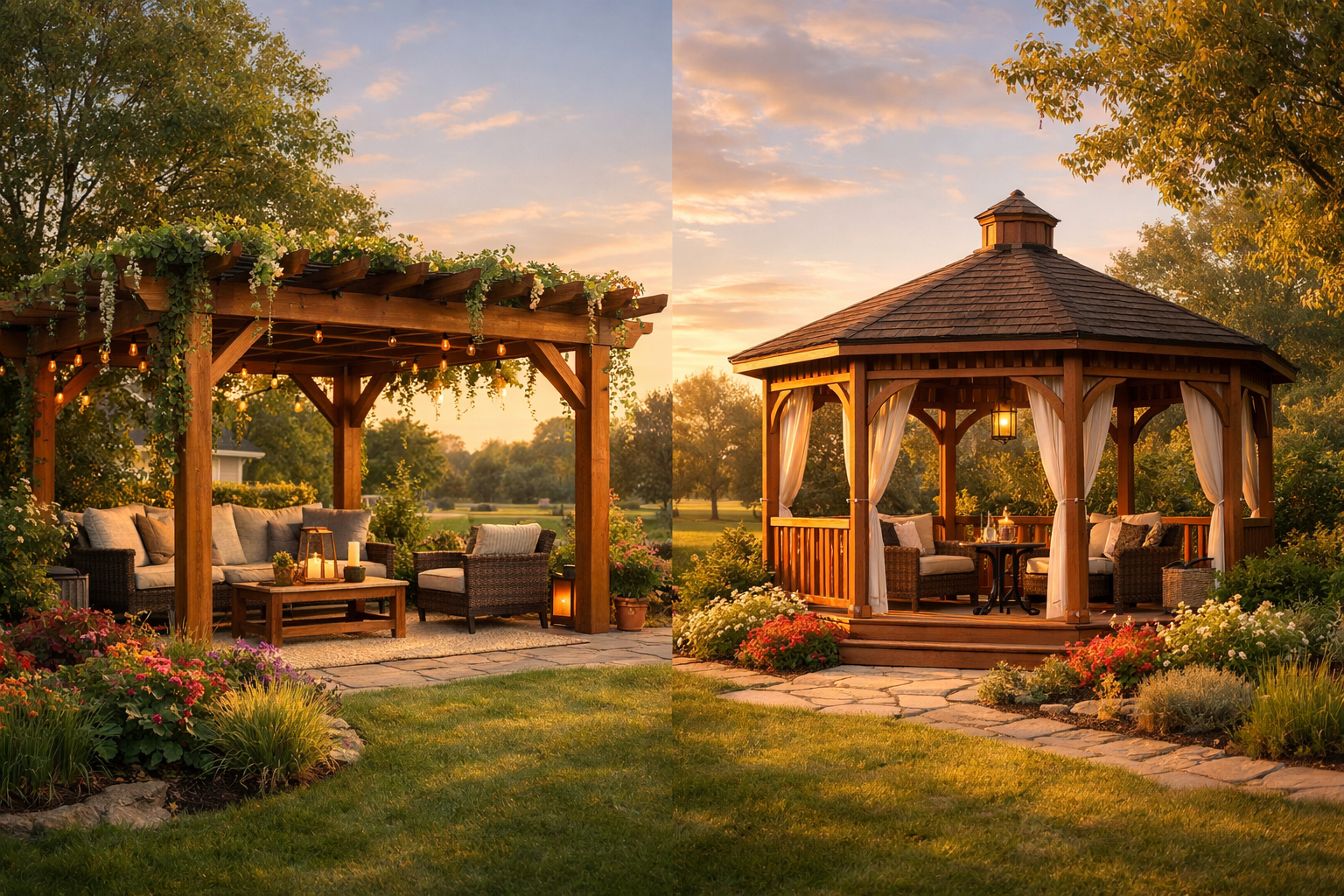
Understanding the Core Difference Between a Pergola and a Gazebo
Before we get into the pros and cons, let’s make sure we’re talking about the same things. I made the mistake early on of using the terms interchangeably, and a contractor politely corrected me in front of my entire family at a backyard barbecue. Mortifying. So here’s the quick breakdown.
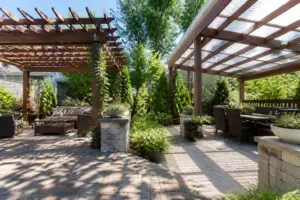
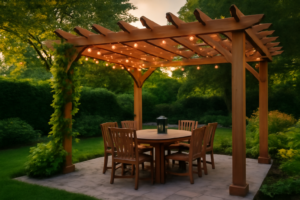
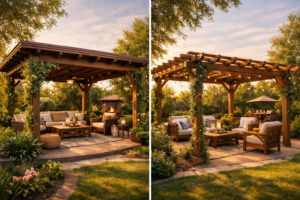
A pergola is an open-roofed structure, typically made of wood or metal, with beams and rafters that create a slatted or latticed ceiling. It provides partial shade and a defined outdoor room without fully enclosing the space. Light filters through, vines can climb up the sides, and breezes move freely. My cedar pergola has that airy, garden-party feel that I absolutely love in good weather.
A gazebo, on the other hand, has a solid roof — often octagonal or rectangular — and is a freestanding structure with a permanent, weather-resistant cover. Karen’s gazebo has a hardtop steel roof with mosquito netting and privacy curtains. It’s basically an outdoor room that happens to have no walls on the inside unless she pulls the curtains. It handles rain, it blocks direct sun completely, and it feels more like a destination in the yard than a passageway.
Both are genuinely wonderful. They just serve different masters.
Pergolas: What They’re Great At (and Where They Fall Short)
I went with a pergola two years ago because I wanted something that felt connected to the garden rather than separate from it. I wanted climbing roses, dappled shade, and the ability to string market lights across the beams without it looking like a parking lot. Mission accomplished on all counts.
If you’re looking for a starting point, the BlueWish 10′ x 12′ Cedar Wood Pergola Kit is one I’ve recommended to several friends. It has a solid slatted trellis roof, comes as a kit, and the cedar construction holds up beautifully to outdoor conditions while giving that warm, natural look. For something with a little more engineering behind it, the Backyard Discovery Beaumont 12′ x 10′ Cedar Pergola Kit includes a high-wind rating and even a PowerPort built in for charging devices outside — which, once you’ve had it, you wonder how you lived without. And if you’ve got a bigger entertaining space to cover, the MUPATER 12×24 FT All-Cedar Pergola Kit is a serious option with snow and wind support for year-round durability.
Here’s what pergolas genuinely do well:
- They integrate beautifully with gardens — climbing plants like wisteria, roses, and clematis thrive on them
- They feel open and airy, which is perfect for pleasant weather
- They’re generally less expensive than gazebos at the same size
- They’re easier to customize with lighting, drapes, and shade sails
- They tend to look more like architecture and less like backyard furniture
But here’s the honest truth: when it rains, you’re done. There’s no sitting under a pergola in a rainstorm unless you’ve added a retractable canopy or waterproof shade panels — which you can do, and many people do, but it’s an extra step and an extra cost. And in peak summer sun, the slatted roof provides shade but not the deep, cool cover of a solid roof.

Gazebos: Built for All-Weather Comfort
Karen bought her gazebo because she hosts a lot of summer dinner parties and was tired of every event being subject to weather negotiation. The hardtop gazebo solved that problem entirely. Now when she sends out invitations, she doesn’t add the words “weather permitting.” That alone might be worth the price of admission for some people.
The Aoxun 10×12 Hardtop Gazebo with Double Galvanized Steel Roof is very similar to what Karen has. It comes with breathable netting and privacy curtains, which means you can have airflow without bugs, or privacy without feeling totally boxed in. The double galvanized steel roof is genuinely weatherproof in a way that no pergola can match without significant modification.
If you’re specifically a griller — and let’s be honest, a lot of backyard decisions are made by people who take grilling very seriously — there are dedicated grill gazebos worth knowing about. The DSNAPE 8′ x 6′ Hardtop BBQ Grill Gazebo has a double galvanized roof, side shelves, and a ceiling hook, all designed around the cooking experience. The EBE 5’x8′ Hardtop Grill Gazebo is a more compact option that still delivers side shelves, hooks, and even a bottle opener built right in — which I think is the single best backyard feature I’ve ever seen.
What gazebos do really well:
- Full rain protection without any modifications
- Deep, consistent shade even in peak afternoon sun
- Mosquito netting options for bug-free evenings
- More of a defined “room” feeling — great for entertaining
- Specific grill models are purpose-built for outdoor cooking setups
The downsides? They can feel enclosed on days when you actually want to be in the open air. They’re typically more expensive. They can look a little out of place in a garden-focused yard. And because the roof is solid, you lose that beautiful play of light and shadow that makes pergolas so visually interesting.

Budget, Space, and the Stuff Nobody Talks About
Let’s talk money for a minute, because I think a lot of people go into this decision a little naively. I did. Pergola kits at the 10×12 size range from roughly $400 to over $2,000 depending on materials and features. Gazebos at comparable sizes tend to start higher and climb faster, especially for hardtop models. That said, the gap isn’t always as dramatic as people expect, and both structures add real value to a property.
Space matters too. Pergolas work beautifully against a house — attached to the back wall above a patio door, they become almost an extension of the interior. Freestanding pergolas work in the middle of a yard or at the end of a garden path, especially when you add an arched entry. A Metal Garden Arch Trellis at 55″ wide and 87″ tall is a perfect companion piece for framing the entrance to a pergola zone, and climbing plants will love it. The Fecita Thickened Rustproof Garden Arch is another excellent option — available in two sizes, with a heavy-duty build that holds up to wind and the weight of established climbing plants.
Gazebos need more clearance and tend to look better as destination structures set away from the house. They need a flat, stable base — gravel, pavers, or a concrete pad. If you’re placing one on an existing patio, measure twice, because those footprints are non-negotiable once the structure is up.
One thing nobody really warns you about: both require more maintenance than you expect in the first year. My cedar pergola needed a fresh coat of sealant after about 14 months. Karen had to re-tighten a few bolts on her gazebo frame after winter. Neither is a “set it and forget it” situation — but both are very manageable with a Saturday afternoon and the right products.

So, Pergola vs Gazebo — Which Is Actually Better for Your Backyard?
After two years of living with a pergola and spending plenty of evenings in Karen’s gazebo, here’s my honest, slightly-biased recommendation: choose a pergola if your priority is garden integration, visual charm, and open-air living in good weather. Choose a gazebo if your priority is reliability, rain protection, and a purpose-built entertaining space you can use on short notice regardless of what the sky is doing.
If you love the idea of a pergola but hate losing it to rain, start with a good cedar kit like the BlueWish 10′ x 12′ Pergola and plan to add a retractable canopy later. If you entertain often and want zero weather stress, go straight to a hardtop like the Aoxun 10×12 Hardtop Gazebo and never look back. And if you’re a serious griller, the dedicated grill gazebos are a category of their own worth exploring seriously.
The question of pergola vs gazebo which is better will always come back to you — your habits, your climate, your yard, and whether you’re the kind of person who cancels plans when it drizzles or the kind who just pulls out an umbrella and carries on. Neither answer is wrong. Mine involves cedar beams and climbing roses. Karen’s involves sangria that stays dry no matter what. Honestly, we’ve both won.
Ready to start planning? Browse the