This post contains affiliate links. As an Amazon Associate, I earn from qualifying purchases at no extra cost to you.
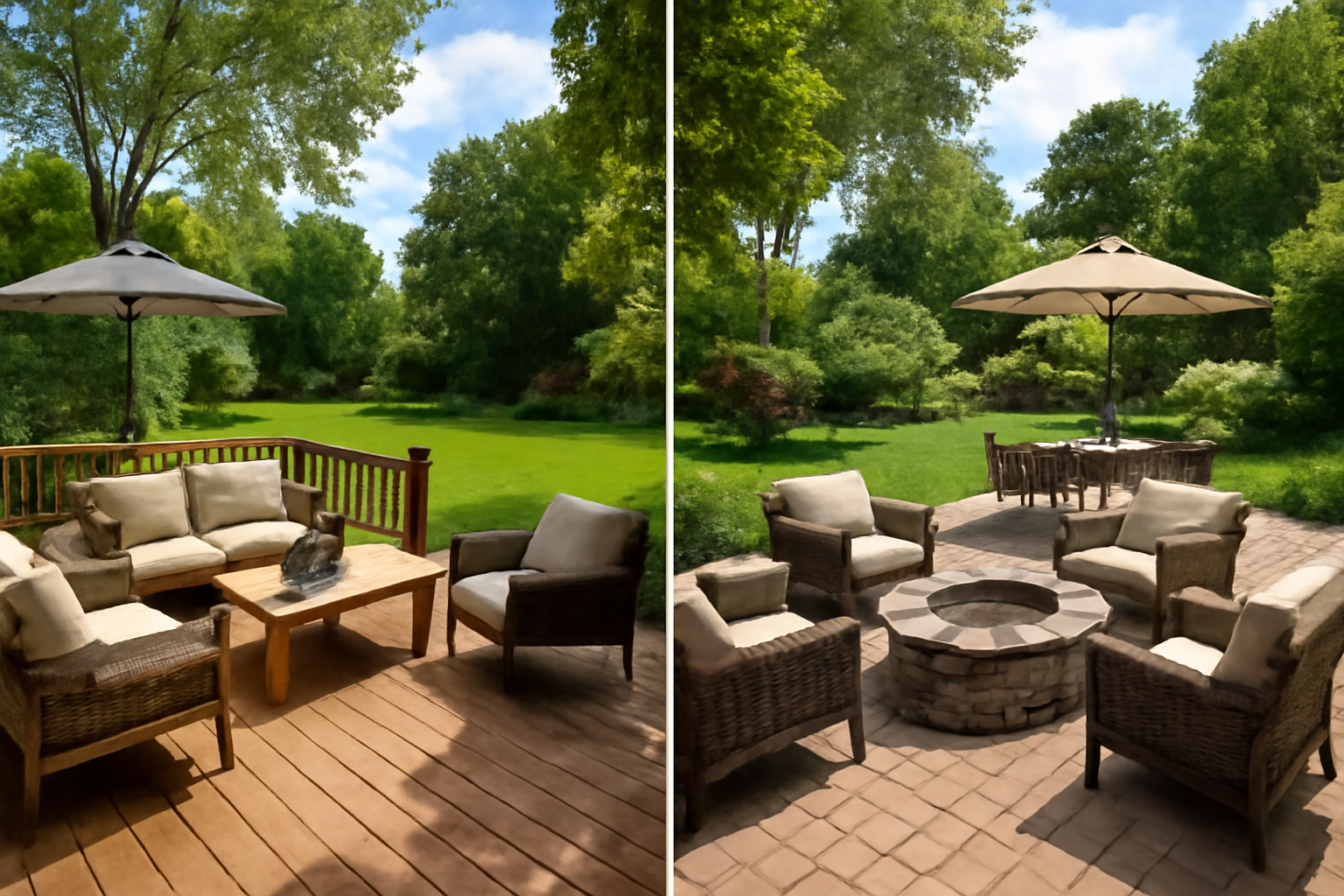
I’ve been on both sides of this decision — and I mean that literally. My backyard has a raised deck off the kitchen and a patio at ground level below it. It took me two separate projects, a few hard lessons, and more weekends than I care to count to figure out which structure belongs where. If you’re trying to decide between a deck vs patio for your own yard, I’m not going to tell you one is universally better than the other. The honest answer is that the right choice depends almost entirely on your specific yard, your budget, how you want to use the space, and how much maintenance you’re willing to commit to over the long haul. Let me walk you through everything I’ve learned so you can make the call that actually fits your situation.
Deck vs Patio: Cost Comparison
Cost is usually the first question, and the honest answer is that patios are almost always cheaper to build — at least on flat ground. A basic gravel patio can run as low as $6 per square foot, while a stamped concrete patio typically lands between $12 and $20 per square foot depending on complexity and your region. On the deck side, a pressure-treated wood deck starts around $15 per square foot installed, and composite decking can push that figure to $30–$35 per square foot once you factor in the framing, hardware, and labor.
To make that tangible: a 300 square foot patio in basic concrete might cost you $4,500–$7,500 installed. That same 300 square feet in pressure-treated wood deck runs $4,500–$9,000, and composite decking puts you squarely at $9,000–$10,500 or more. On paper, the patio wins on upfront cost for most builds. But as I’ll get into below, that comparison shifts once you factor in terrain, maintenance, and longevity.
If you’re drawn to composite but not ready to commit to a full installation cost, I’d strongly recommend ordering the ShunHong Outdoor Solid Composite Decking Boards Color Samples Pack 0.5″ before you buy. I did exactly this before finalizing my deck build, and it saved me from choosing a color I would have regretted. The pack includes three solid-profile sample pieces so you can see exactly how the tone and texture look in your actual outdoor lighting conditions — morning sun versus afternoon shade makes a significant difference. It’s a small investment that eliminates a very expensive guessing game.
When a Deck Is the Better Choice
There are four situations where I’d push you toward a deck without hesitation, and the first one is a sloped yard. If your backyard drops more than a foot or two from the house, a patio requires serious grading or a retaining wall — both of which add substantial cost and disruption. A deck, by contrast, simply extends out from the house on posts and remains level regardless of what the ground below is doing. My first deck covered a slope that would have taken thousands of dollars in excavation to flatten. The deck solved that problem cleanly.
Second, if your home has an elevated entry — a walkout from a second floor, a raised foundation, or a back door that sits several feet off grade — a deck is essentially the only practical solution. You’re not going to build a patio up to meet a door that’s four feet off the ground. Third, wooded lots almost always favor decks. You can build around existing trees, preserve root systems, and create something that feels like it belongs in a natural setting rather than fighting it. Finally, elevation matters for views. My deck looks out over a tree line that my ground-level patio completely misses. If you have any kind of view worth capturing, height helps.
If you’re exploring composite decking profiles and want to compare how different surface textures perform outdoors, the ShunHong Circle Hole Outdoor Composite Decking Boards Color Samples Pack is worth having alongside the solid version. The circle-hole profile has a slightly different aesthetic and drainage characteristic that I noticed immediately when I held the two side by side. For poolside or high-moisture applications, that open profile can be a meaningful advantage. Getting physical samples of both profiles before committing is just smart planning.
When a Patio Is the Better Choice
A flat yard is a patio’s best friend. When the ground is already level, there’s no structural complexity — you’re essentially laying material on a prepared base and calling it done. The cost savings are real, the installation is faster, and the result is just as functional as anything a deck could offer in that same footprint. If your yard is flat and you don’t have a view to gain from elevation, save the money and go with a patio.
Ground-level living is also a genuine lifestyle advantage. No stairs means easier access for older family members, guests with mobility considerations, pets, and kids who are still figuring out steps. My lower patio gets far more casual daily use than the deck precisely because there’s no barrier to stepping outside. Additionally, if you want a fire pit, a patio is significantly safer. Open flame directly on a wood deck — even a composite one — is a real risk. Fire pits belong on non-combustible surfaces, and concrete, stone, and pavers deliver exactly that. Finally, on the patio vs deck longevity question, concrete and natural stone simply outlast wood. A well-installed concrete patio can last 30 or more years with minimal intervention.
For a patio surface that doesn’t require a full concrete pour, the 3rd Street Inn Slate Stone Tiles – Stone Outdoor Interlocking Patio/Deck Flooring Tiles are something I’ve come back to repeatedly for smaller projects. The 12″ x 12″ interlocking slate tiles install without mortar or adhesive, which means you can create a finished patio surface in an afternoon. What stands out to me is the natural stone variation in the Colorful Stone finish — no two tiles look identical, which gives you the organic aesthetic of a laid stone patio without the cost or permanence of a full hardscape installation. The 18-pack covers a meaningful area and works equally well indoors or out.
Maintenance: The Real Long-Term Difference
This section is where the deck vs patio decision gets real for a lot of homeowners, because upfront cost is only part of the picture. A pressure-treated wood deck needs annual cleaning and staining or sealing every two to three years to stay protected from moisture, UV, and foot traffic. Skip that cycle a couple of times and you’re looking at cupped boards, gray weathering, and eventually rot. Composite decking dramatically reduces that burden — most quality composite products need nothing more than a periodic wash — but it still requires occasional attention to prevent mold and mildew in shaded areas.
Patios are generally lower maintenance, but not maintenance-free. Concrete benefits from sealing every three to five years to resist staining and freeze-thaw damage. Pavers need periodic re-sanding of joints and sealing on a similar schedule. Pressure washing once a year keeps both looking fresh. If you have a plain concrete slab, you can honestly go years without doing much beyond keeping it clean. On balance, if low maintenance is a priority, patio vs deck comes out in favor of the patio — especially a concrete or stone installation.
For anyone who wants a quick, low-commitment surface refresh on a deck or patio without a major project, I’ve found the Goovilla Plastic Interlocking Deck Tiles to be a surprisingly practical solution. I used a set on a corner of my concrete patio that sees heavy chair drag and was starting to show wear, and the dark grey tiles snapped together in minutes with no tools. The waterproof construction and all-weather rating mean they hold up through freeze cycles and rain without warping or fading. For balconies, pool surrounds, or any area where you need a durable, attractive surface fast, these are genuinely worth considering.
The Best of Both Worlds: Combining Deck and Patio
Here’s the thing nobody tells you early enough in the planning process: deck or patio doesn’t have to be an either/or decision. Some of the best outdoor spaces I’ve seen — including my own backyard — use both structures together as a layered system. The most natural configuration is a deck at the house level that steps down via stairs to a patio below. Each level serves a distinct purpose, and together they give you far more usable outdoor square footage than either one alone.
In my setup, the deck handles dining and grilling — it’s elevated, it catches the breeze, and it’s steps from the kitchen. The lower patio is where the fire pit lives, where we put out the extra seating for larger gatherings, and where the kids have room to spread out. The transition between the two actually creates a natural flow for entertaining. If you’re weighing deck or patio and have the budget and space for both, I’d encourage you to think about them as a system rather than competing options. The planning takes a bit more thought upfront, but the result is an outdoor living area that genuinely works for multiple activities at the same time.
Final Thoughts
After going through both builds myself, my honest takeaway is this: the deck vs patio question is really a yard question more than anything else. Look at your slope, your entry points, your intended use, and your realistic maintenance bandwidth. Flat yard with a fire pit and accessibility needs? Build the patio. Sloped lot with an elevated door and a view? The deck earns its cost. If you can do both eventually, plan for them to work together from day one — your future self will thank you. Whichever direction you go, take the time to get samples in your hands, think through the long-term upkeep, and build something that actually fits the way you live outside.