This post contains affiliate links. As an Amazon Associate, I earn from qualifying purchases at no extra cost to you.
Last spring, I was three days into building a 380-square-foot concrete paver patio behind my house when my neighbor walked over and asked a simple question. “How are you handling the laser level patio slope drainage?” I stared at him. I had a string line. I had a line level. I had 15 years of hardscaping experience. But I was also standing in a low spot that collected two inches of standing water every time it rained. Clearly, my old methods weren’t cutting it anymore.
That conversation started a two-week research spiral. It ended with me ordering the DOVOH Outdoor Laser Level with Receiver (H3-360G). It also saved me from what would have been a very expensive, very ugly drainage disaster.
I want to walk you through exactly what happened — the project, the tool, and the results. If you’re building or regrading any outdoor surface where water management matters, this post is for you.
The Project That Made Me Stop Guessing
My backyard patio project wasn’t a small weekend job. The plan was a full 380-square-foot concrete paver surface, approximately 20 feet wide by 19 feet deep, running off the back of my house toward a planted border. The slope needed to drain away from the foundation at a minimum 1/8 inch per foot — roughly 2.5 inches of total drop across 20 feet.
That sounds manageable with string lines. In my experience, however, string lines sag. They shift in the wind. They lie to you around the third hour of a hot day. My old 48-inch torpedo level wasn’t going to help me hit precise grades across a 20-foot span either.
I had already bought and stacked $1,200 worth of Belgard Urbana pavers in my driveway. The base prep alone — 4 inches of crushed limestone topped with 1 inch of bedding sand — had taken two full weekends. Getting the grade wrong at this stage would mean water pooling against my house sill plate, which sits just 6 inches above grade. That’s a rot problem waiting to happen.
Why I Chose the DOVOH Outdoor Laser Level H3-360G
My neighbor — a retired general contractor with 30 years on commercial sites — pointed me toward self-leveling rotary or 360-degree line lasers. Specifically, he mentioned using outdoor-rated models with a detector because green beam lasers are nearly invisible in full sun without one.
That narrowed my search considerably. I needed outdoor range, a green beam, and a compatible receiver. After two evenings on YouTube and about four hours reading Amazon reviews, the DOVOH Outdoor Laser Level with Receiver, H3-360G kept surfacing in contractor forums and DIY patio build videos.
The listed specs sealed it for me. Up to 400-foot range with the detector. Green beam for visibility. Self-leveling within 4 degrees. IP54 dust and water resistance. The price point — around $89 at the time — was also significantly lower than comparable Bosch or Dewalt units in the $180–$250 range.
Honestly, I almost bought the Dewalt. That said, for a DIY homeowner doing occasional outdoor projects, spending twice as much for a brand name felt hard to justify. The DOVOH reviews were strong and consistent. I pulled the trigger.
First Impressions: Unboxing and Build Quality
The package arrived in two days. Inside the box: the laser unit itself, the detector/receiver, a magnetic mounting bracket for the receiver, a tripod adapter, batteries, and a carrying case. Everything was snug in molded foam. Nothing rattled. That’s a good sign for a precision instrument.
The laser unit is heavier than I expected — about 1.8 pounds. It feels solid in hand. The housing is rubberized on the sides with a matte plastic top. There are no creaks or flex points when you grip it. The self-leveling pendulum locks with a physical switch, which I appreciate. It protects the mechanism during transport.
The receiver is slim — roughly the size of a TV remote — with a bright LED indicator and an audible beep. Three modes: above grade, on grade, and below grade. Simple. Intuitive. Even without reading the instructions, I had it figured out in about four minutes.
Setup onto my existing camera tripod took under a minute. The 5/8-inch threaded mount is standard. If you already own a decent tripod, you’re good to go. If not, the kit includes a basic stake-style rod mount that works on gravel or soft ground.
Putting It to Work on the Patio Slope
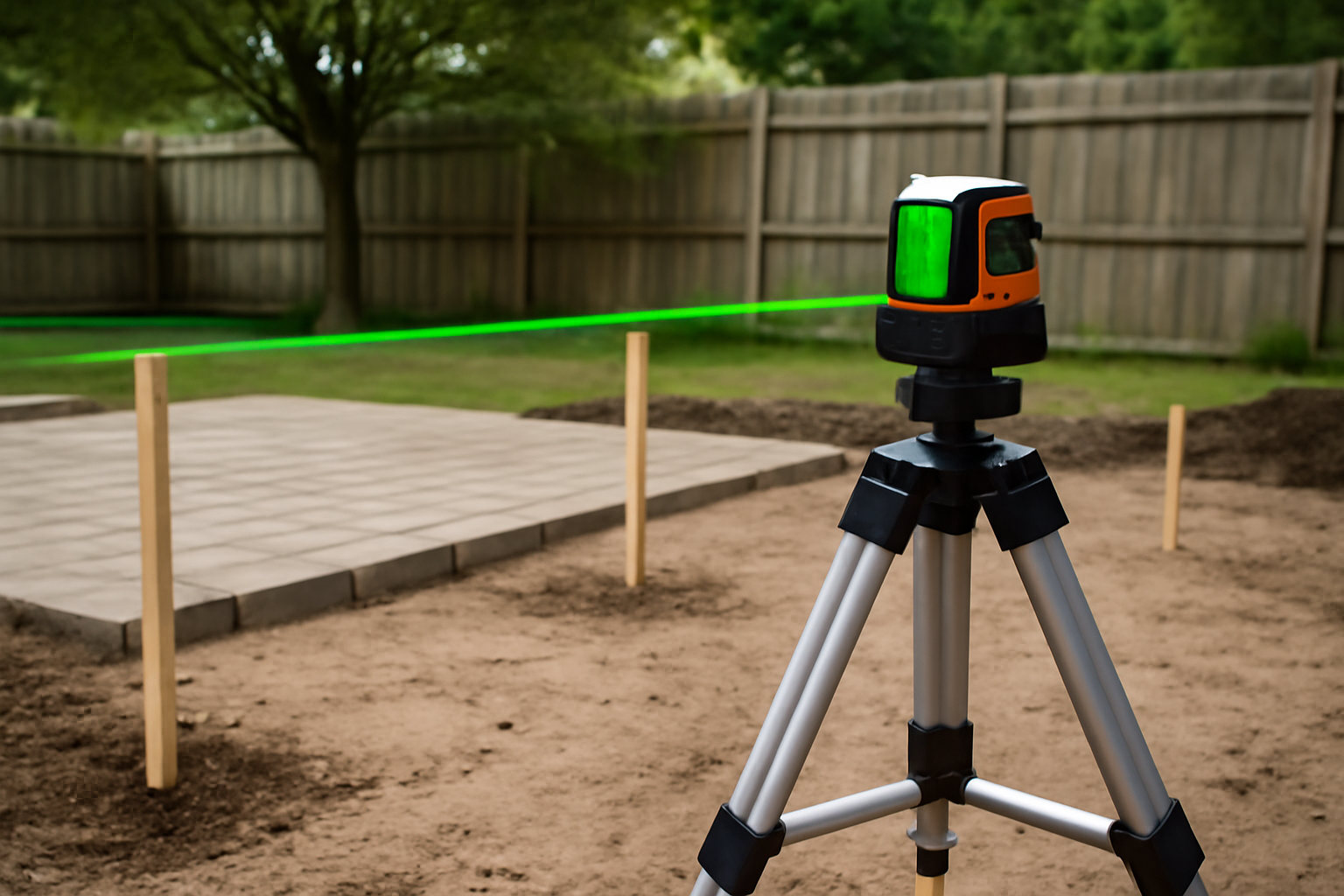
I set up the DOVOH H3-360G on a tripod at the highest corner of my project — the corner closest to the house foundation. I established my reference height at 6 inches above the finished paver surface. From that single point, I could now check grade anywhere within the 380-square-foot area.
Conditions that day: late April, partly cloudy, around 72°F, light wind. Without the receiver, the green line was still difficult to see beyond about 15 feet in open shade. With the receiver clipped to a grade rod, I was reading clean signals at the full 20-foot working distance without any strain.
Here’s what I found. My base course had a 1.5-inch low spot running diagonally across the center of the slab. My string lines had completely missed it. That single low spot would have created a subtle bowl in the finished surface — exactly the kind of thing that holds a quarter-inch of water after every rain and slowly undermines your bedding sand.
I spent about 90 minutes regrading that area with additional crushed stone base and re-checking with the laser. Every adjustment was confirmed in real time. No guessing. No re-pulling string lines. The final grade checked out at 1/4 inch per foot across the entire 20-foot run — slightly better than my minimum target.
Testing Across Multiple Days and Conditions
I ran the DOVOH Outdoor Laser Level with Receiver across three separate work sessions over two weeks. One session was overcast and cool — maybe 55°F with light drizzle. The IP54 rating held up without issue. The unit stayed dry. The receiver performed identically to clear-day sessions.
On the warmest day — about 83°F with direct sun — I confirmed that the green beam is indeed difficult to see with the naked eye outdoors. The receiver, however, made that a non-issue. That’s the intended workflow for outdoor use. Don’t expect to chase a beam across your yard in July. Use the detector as designed, and it works exactly as advertised.
What I Loved About the DOVOH H3-360G
Let me be specific. These are the things that genuinely impressed me after real project use.
- Accuracy at distance: At 20 feet, my grade checks were consistent to within 1/16 inch. That’s better than string line work on a calm day, and dramatically better in any wind.
- Self-leveling speed: The pendulum settles in about 4–5 seconds after placement. Quick and reliable every time.
- Receiver clarity: The audible beep and LED indicator make solo grading work genuinely practical. No helper needed to spot the beam.
- Battery life: I used four AA batteries across all three sessions — roughly 9 hours of intermittent use — and never replaced them.
- Price-to-performance ratio: At roughly $89, this replaced a workflow that required two people, three string lines, and still produced worse results.
The biggest win was confidence. Every course of pavers went down knowing the base was exactly right. That matters on a project where re-doing the work would cost $300–$400 in materials and two full weekends of labor.
The Downsides You Should Know
I want to be straight with you here. No tool is perfect, and this one has limitations worth knowing before you buy.
The tripod is not included. The product listing can feel slightly misleading on this point. You get a mounting adapter and a stake rod. For patio grading work, you really want a stable tripod. Budget an additional $25–$40 if you don’t already own one.
Naked-eye visibility outdoors is limited. In direct sunlight, the green line disappears past 10–12 feet without the receiver. That’s not a design flaw — it’s physics. However, if you expected to use this for quick visual checks without the detector, you’ll be disappointed on sunny days.
The carrying case is basic. It’s a molded plastic shell — functional, but not particularly rugged. For a contractor throwing tools in and out of a truck daily, I’d want something more protective. For a homeowner storing it in a garage between projects, it’s fine.
The instruction manual is thin. Most setup is intuitive, but the technical specifications page is sparse. Finding the self-leveling range (±4°) required me to check the Amazon listing, not the manual. Minor issue, but worth noting.
One moment of genuine doubt: during my first session, the unit beeped an out-of-level error twice. My tripod legs had sunk slightly into soft ground between checks. Once I moved to a firmer base, the issue disappeared completely. Still, it gave me a brief “did I buy a lemon?” moment that I want to be honest about.
Final Verdict: Who Should Buy This Laser Level for Patio Slope Drainage Work
If you’re a DIY homeowner tackling any outdoor project where laser level patio slope drainage accuracy actually matters — patios, walkways, retaining wall base prep, yard regrading, or driveway aprons — the DOVOH Outdoor Laser Level with Receiver H3-360G is a legitimate upgrade over string lines and spirit levels.
It’s accurate. It’s durable enough for weekend warrior use. The receiver makes solo grading work genuinely practical. At under $100, the value is hard to argue with — especially when the alternative is a drainage mistake that costs you $500 to fix and a foundation that’s slowly getting wet.
Buy this if: You’re a DIY homeowner doing occasional hardscaping, grading, or landscaping projects and want professional-level accuracy without a professional tool budget.
Skip it if: You’re a working contractor who needs daily jobsite durability and a more robust case system. In that case, step up to a Bosch or Dewalt with a full warranty program behind it.
For me, it caught a drainage mistake I would never have found with string lines. That single catch justified the purchase price three times over.
Runner-Up Option Worth Considering
If the DOVOH is out of stock or you want a slightly more compact kit, take a look at the Firecore F93 Laser Level with Receiver Kit. It features a rechargeable battery — a genuine convenience advantage — and solid 1/13-inch accuracy at close range. The tradeoff is a shorter 197-foot working range with the detector versus the DOVOH’s 400-foot reach.
For smaller residential projects under 50 feet, that range difference is irrelevant. The built-in USB charging is genuinely more convenient than swapping AA batteries. On the other hand, for larger grading projects or longer lot runs, the DOVOH’s extended range gives you more flexibility. Either way, both tools represent a major upgrade over traditional leveling methods for outdoor drainage work.