I spent two years watching homeowners spend thousands on new patios and sealed concrete only to avoid their backyards after sunset—not because the spaces weren’t beautiful, but because they’d become black voids the moment the sun dipped below the horizon. The worst part wasn’t the wasted investment; it was watching them retreat inside, convinced their outdoor living areas simply didn’t work for evening entertaining. That’s when I understood that outdoor lighting isn’t some finishing flourish you add if you have budget left over—it’s the difference between a space that functions and one that sits dark and unused half the year. Get the lighting strategy wrong, and even the most immaculate sealed driveway or freshly finished patio becomes invisible the moment dusk arrives.
My neighbor Karen stopped by the next evening, took one look at my patio, and said, “Oh wow — are you seeing someone?” My wife was away at her sister’s that week. I was sharing the place with a cat named Brisket. I was eating cereal on a lawn chair. And yet, somehow, the vibe was undeniably… swoon-worthy.
How It All Started (With a Face-Plant)
It started on a Tuesday in September when I walked outside after dark to drag the recycling bins to the curb and absolutely bit it on a coil of garden hose I’d left on the patio. Just a full, dignified, slow-motion tumble into the lawn furniture. My outdoor space had zero lighting — not a single bulb — and I had been navigating it by memory and optimism for two years. The optimism finally failed me.
So I did what any reasonable adult does after an embarrassing solo wipeout: I opened Amazon at 11 PM and bought string lights. Multiple string lights. With the confidence of someone who has absolutely no plan.
When the boxes arrived, I dragged everything outside on a Saturday morning with a cup of coffee, a staple gun, and the kind of misplaced certainty that only comes before you’ve actually attempted something. Three hours later, I had lights strung in a pattern that can only be described as “what if a disco ball had a fever dream.” There were zigzags. There were drooping sections. One strand made a shape that looked vaguely like a question mark, which honestly felt appropriate.
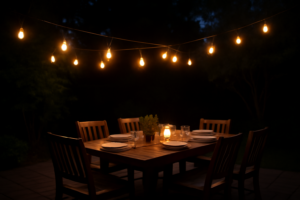
I plugged it all in at dusk — and I genuinely gasped. It was beautiful. Not because I had done anything skillfully. But because warm Edison-style bulbs glowing at golden hour are just magic, full stop. My chaotic staple-gun art had somehow worked.
What I Learned About Backyard String Lights (The Hard Way)
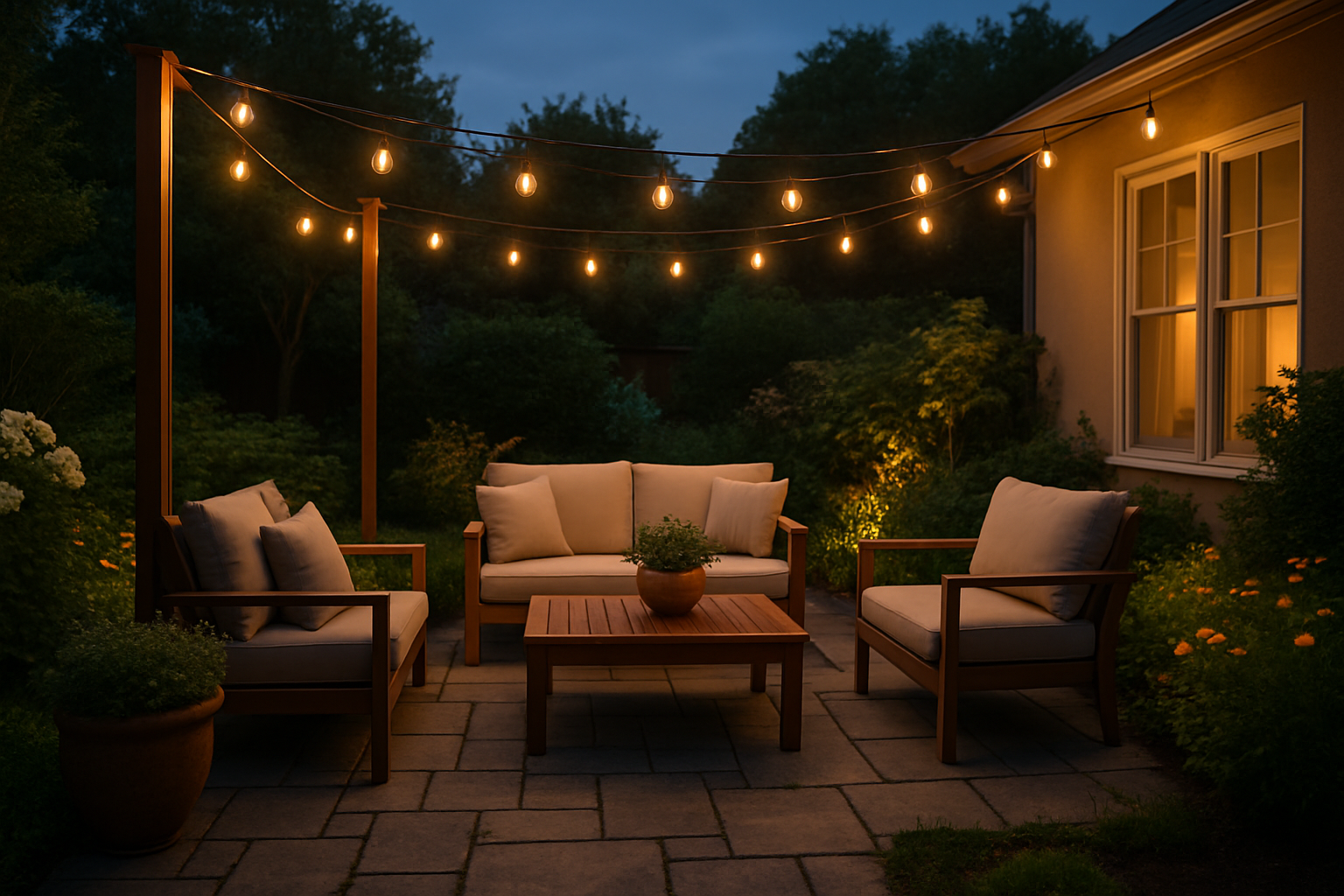
After my accidental romance novel launch, I actually went back and did things properly — researching, re-stringing, and adding mounting poles so the lights were taut, intentional, and safe. Here’s what I wish I’d known before round one.
Plan Your Layout Before You Buy
Sketch your space — seriously, even a rough drawing on a napkin helps. Measure the distance between anchor points and add 10–15% for sag and draping. A grid pattern (parallel strands running the same direction) looks structured and modern. A canopy effect (strands radiating from a central point) feels festive and cozy. A zigzag or catenary drape is classic and forgiving for irregular spaces. Pick one and commit. Do not do all three at once like I did initially.
Choose the Right Bulb and Strand Length
For most backyard setups, you’ll want a warm white color temperature — around 2700K — for that golden, flattering glow. ST38 Edison-style bulbs are the industry sweet spot: they cast beautiful light, look stunning when unlit during the day, and the shatterproof versions are genuinely important if you have kids, pets, or simply exist near outdoor furniture. For strand length, measure twice and buy longer than you think you need. Running out of lights two feet from your endpoint is a special kind of frustrating.
Anchor Points Are Everything
This is where most DIY string light projects fall apart — literally. If you don’t have structures to anchor to (a fence, pergola, or posts), the lights will sag, pull, and potentially come down entirely in the first wind. Dedicated string light poles are the solution, and they’re much easier to install than you’d think. Look for poles that are rust-resistant, have a forked or hook top, and come with ground stakes or deck-mount brackets depending on your surface.
Use a Dimmer or Smart Plug
Full brightness is great for parties. For regular evenings, dimming your string lights down to 60–70% intensity creates a softer, warmer atmosphere and extends the life of your bulbs significantly. Many string lights are dimmable — just make sure you’re pairing them with a compatible dimmer switch or smart outlet. This single upgrade transforms a nice yard into an exceptional yard.
What I Used — My Recommended Products
These are the specific products I landed on after my trial-and-error saga. All of them are genuinely worth it.
The String Lights That Finally Made My Spacing Instincts Matter
Most string lights fail because they’re too short to define a real zone or too dim to actually read the space they’re supposed to illuminate. The 50-foot length is the sweet spot—long enough to span a driveway approach or patio perimeter without looking like you’re stretching budget-store lights across a department store parking lot.
What works
- The 50-foot run covers most single-zone applications without requiring multiple spliced sets, so you get clean sightlines and one plug point instead of a daisy chain of extension cords
- LED bulbs stay cool enough that you can actually run these year-round without worrying about melting insulation or fire risk—critical if you’re mounting them near wood fascia or sealing work
- The warm white tone reads as intentional, not like you grabbed whatever was on clearance; it actually complements concrete and pavers instead of washing them out
What doesn’t
- You’ll need sturdy anchor points or poles—drooping lights undersell even a well-sealed driveway, so factor in installation hardware before you commit
- The cord is visible, and 50 feet of black rubber running across your space reads as an afterthought unless you route it intentionally (along a fence line, buried slightly, or disguised with landscaping)
I had a moment where I hung these loosely across my test driveway and they looked cheap—until I tightened the run, tucked the cord, and suddenly the whole entry felt designed instead of decorated. If you’re willing to spend 30 minutes on proper routing, addlon 50FT Outdoor String Lights LED with Remote Dimmable Waterproof will change how your sealed surfaces photograph and feel at night.
About This Article

Written by Marcus Delvecchio. Marcus Delvecchio isn't a licensed contractor — he's a handyman and DIY outdoor landscaper who got obsessed with driveways, patios and pavers after redoing his own place badly enough to want to understand why. Twenty years later he spends his weekends on his own projects and on side jobs for neighbours and friends around the mid-Atlantic, and writes up what actually worked, mistakes included. More about this site.
Scope and limits. Marcus is a homeowner who got obsessive about driveways, not a licensed contractor. Structural repair, drainage changes, and anything requiring a permit should go to a licensed contractor.
Verify this against a primary source
Specifics change, and your situation may differ from the one described here. These are the authorities worth checking directly:
- Concrete Masonry & Hardscapes Association — segmental paver installation standards
- National Asphalt Pavement Association — asphalt placement and maintenance guidance
- Portland Cement Association — concrete durability and jointing