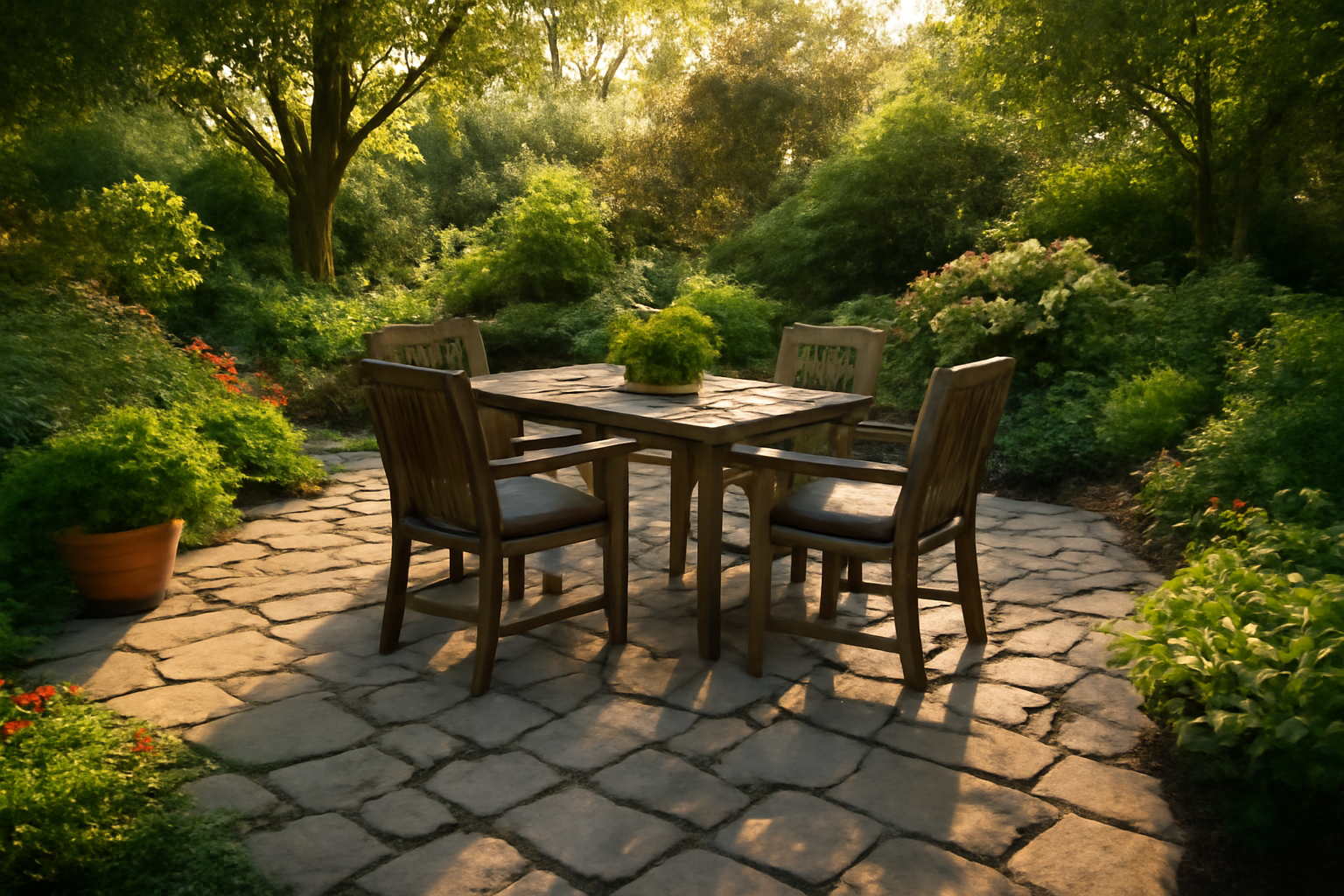
A few years back, a homeowner called me in a panic. She had poured a beautiful 400-square-foot concrete patio the previous spring — smooth finish, clean edges, exactly what she asked for. By the following March, after one hard Wisconsin winter, it had cracked in three places. Not hairline cracks. I’m talking quarter-inch gaps you could lose a finger in. The contractor who poured it had disappeared. I ended up jackhammering the whole thing out and starting over — this time with pavers.
That story is not unusual. I’ve seen it play out dozens of times in 17 years of doing this work. And yet, concrete remains the first thing most homeowners ask for when they call me. It’s familiar. It feels permanent. The price quote looks reasonable on paper. So every single consultation, I have the same conversation — and most of the time, I talk them out of it.
Here’s everything I wish the industry would just say upfront about the concrete patio vs pavers debate.
The Real Problem With Poured Concrete
Concrete isn’t a bad material. It’s an inflexible one — literally and figuratively. And that’s exactly the problem when you’re laying it over ground that moves.
Soil expands and contracts with moisture and temperature. In climates with freeze-thaw cycles (which is most of the United States above the Sun Belt), water works its way under a concrete slab, freezes, expands, and puts upward pressure on whatever is above it. Concrete doesn’t flex. It breaks. The American Concrete Institute acknowledges that surface cracking in residential slabs is, in their own language, “expected” and “normal.” That’s the industry’s polite way of saying: your patio will crack. The only question is when.
Beyond cracking, poured concrete gives you almost no recovery options. When a slab settles unevenly, you’re looking at mudjacking (pumping grout underneath to lift it), slabjacking with polyurethane foam, or full removal. Mudjacking runs $500–$1,200 for a typical residential job. Full removal and replacement on a 400-square-foot slab? I’ve quoted that work at $3,800–$6,500 depending on access and disposal costs. That’s money spent just getting back to zero.
Why Pavers Solve the Problems Concrete Creates
Individual pavers — whether concrete, natural stone, brick, or engineered composite — are designed to move independently. That’s not a weakness. That’s the entire point.
When the ground shifts under a paver installation, individual units settle or lift slightly. You can see it. You can fix it. You pull the affected pavers, re-level the base material, reset the units, and re-sand the joints. I’ve done repairs like this in under two hours that would have required a full slab replacement in poured concrete. The material cost is close to zero if you keep spare pavers on hand — which I always tell clients to do.
The other thing pavers give you is drainage. Traditional poured concrete is impervious — water runs off the surface, which creates pooling issues and contributes to erosion around the perimeter. A properly installed paver system with polymeric sand joints (I’ve been using Gator Base systems and Alliance Gator polymeric sand for close to a decade) allows water to filter through joint spaces into a compacted gravel base. This is better for your landscape, better for nearby foundations, and increasingly required by local stormwater ordinances in many municipalities.
The Installation Difference Nobody Talks About
Here’s what I tell every client who thinks concrete is easier or faster: a concrete pour requires the right weather window, the right subgrade preparation, proper curing time (28 days for full strength), control joint placement to manage inevitable cracking, and a sealer applied at the right moisture content. Done wrong at any one of those steps, you get problems that are expensive to fix.
A paver installation also requires proper base preparation — I use a minimum of 6 inches of compacted crushed stone base for patios, 4 inches for low-traffic pathways — but the individual steps are more forgiving. If I pull up on a job and the sand layer isn’t reading level, I fix it before I set the first unit. With concrete, once you pour, you’ve committed.
I’ve also fixed enough bad paver jobs to know that skipping base depth is the number one installation failure point. Any contractor quoting you a “gravel-free” or “minimal base” paver install is setting you up for the same failure mode as concrete — just slower and less dramatic.
Where Concrete Still Makes Sense (Honest Caveat)
I said I talk almost every client out of concrete. Not every one.
If you have a very large, flat, well-drained slab area in a mild climate — parts of Southern California, coastal Florida, Arizona — poured concrete can perform well for 20-plus years with proper reinforcement and control joints. It’s also lower maintenance in the short term. You’re not re-sanding joints every few years. And for certain architectural styles — ultra-modern homes with clean geometries — a polished or exposed aggregate concrete surface is genuinely hard to replicate with pavers.
I also won’t pretend pavers are cheaper upfront. On a comparable square footage basis, a quality paver installation typically runs 15–30% more than poured concrete at installation. My argument to clients is always total cost of ownership over 10 and 20 years. Pavers almost always win that math. But if your budget is tight and your timeline is short, I understand the appeal of concrete.
What I Recommend for DIY and Smaller Spaces
Not every project needs a full contractor install. For balconies, small patios, pool surrounds, and porch areas, there’s a generation of interlocking tile and paver systems that have genuinely impressed me in recent years. These work on existing surfaces or over compacted bases and give homeowners the flexibility of a paver system without the full excavation and base build.
Here are the products I’ve reviewed and would recommend to clients doing smaller DIY installations:
- For pool decks, patios, and balconies: The Goovilla Plastic Interlocking Deck Tiles (9 Pack, 12″x12″, Dark Grey) are a practical option for all-weather outdoor use. The interlocking system handles thermal movement well, and the dark grey colorway holds up without looking faded after a season or two of UV exposure.
- For a natural stone look without the weight: The Slate Stone Deck Tiles Interlocking Outdoor Flooring bring a genuine slate aesthetic to indoor-outdoor floor applications. They work well on decks and covered patio areas where you want the visual weight of natural stone without committing to a full masonry installation.
- For garden pathways: The Arcadia Garden Products Fiberclay Stepping Stones (Set of 4, 16×17″, Dark Gray) are a standout for pathway applications. Fiberclay is significantly lighter than concrete but reads visually the same — important if you’re setting stones into a planting bed or lawn where a full concrete paver would compact the soil. The repeatable natural stone pattern looks intentional, not cheap.
The Bottom Line After 17 Years
I’ve poured concrete. I’ve pulled up concrete. I’ve watched beautiful new concrete slabs crack in their first winter and I’ve watched homeowners spend money on the same square footage twice. I’ve also installed paver systems that are now 15 years old and still level, still draining properly, and still looking sharp with nothing more than a joint sand refresh every four or five years.
The concrete patio vs pavers question isn’t really about aesthetics anymore — both options look great. It’s about whether you want a material that handles real-world ground movement or one that resists it until it doesn’t. In almost every residential scenario, pavers are the more forgiving, more repairable, and more durable choice over the long run.
If you’re starting to plan an outdoor project, start there. Get the base right, choose the right unit for your traffic and climate, and you’ll have an outdoor space that holds up — not one you’re calling me to fix in year three.
The Interlocking Tiles That Saved Me From Becoming a Concrete Repair Specialist
After that Wisconsin patio disaster, I realized I was spending more time jackhammering failed concrete than actually helping homeowners enjoy their outdoor spaces. What I needed was something that looked finished, handled freeze-thaw cycles without cracking, and didn’t require a contractor’s license to install correctly.
What works
- Zero curing time — you walk on them the same day, which means no winter weather surprises or seasonal cracking surprises waiting three months down the line.
- Individual tiles mean failed sections are a 10-minute replacement, not a $4,000 jackhammer job — and you can actually do it yourself without special equipment.
- They move independently during freeze-thaw cycles instead of fighting it, which is why I stopped seeing quarter-inch gaps by March.
What doesn’t
- They’re plastic, so if you’re expecting the permanence of poured concrete, you’re setting yourself up for disappointment — these are a different category entirely.
- Snow removal and heavy equipment can shift them over time, so they work best for patios and walkways, not active driveway surfaces taking constant truck traffic.
I’ll admit my first installation with interlocking tiles felt cheap compared to that smooth concrete patio the Wisconsin homeowner had originally wanted — until I watched it survive two winters without a single crack and realized I’d actually solved the problem instead of just delaying it. If you’re tired of the concrete repair cycle, grab a set of Goovilla Plastic Interlocking Deck Tiles (9 Pack, 12″x12″, Dark Grey) and see what I mean.
About This Article

Written by Marcus Delvecchio. Marcus Delvecchio isn't a licensed contractor — he's a handyman and DIY outdoor landscaper who got obsessed with driveways, patios and pavers after redoing his own place badly enough to want to understand why. Twenty years later he spends his weekends on his own projects and on side jobs for neighbours and friends around the mid-Atlantic, and writes up what actually worked, mistakes included. More about this site.
Scope and limits. Marcus is a homeowner who got obsessive about driveways, not a licensed contractor. Structural repair, drainage changes, and anything requiring a permit should go to a licensed contractor.
Verify this against a primary source
Specifics change, and your situation may differ from the one described here. These are the authorities worth checking directly:
- Concrete Masonry & Hardscapes Association — segmental paver installation standards
- National Asphalt Pavement Association — asphalt placement and maintenance guidance
- Portland Cement Association — concrete durability and jointing