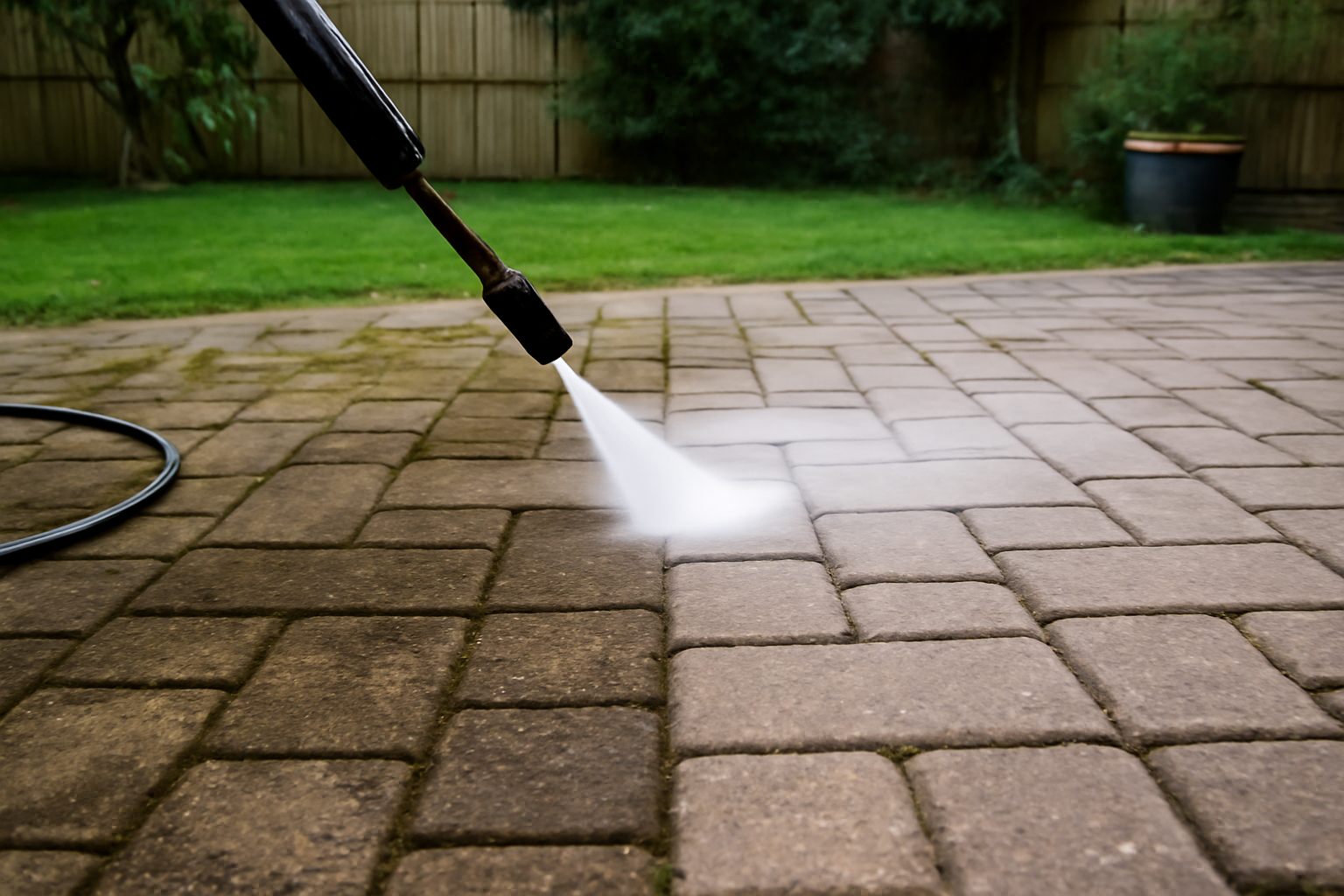
Last spring, I finally hit my breaking point with my patio pavers. After six years of Minnesota winters, spring runoff, and general neglect, the 380-square-foot travertine patio behind my house looked like the surface of the moon. Moss had crept into every joint. Black algae streaked across the field tiles. Bird droppings had practically calcified onto the surface near the pergola. I knew I needed a deep-clean before re-sanding and sealing—and I knew a garden hose wasn’t going to cut it. That’s when I started seriously researching how to use a pressure washer on travertine specifically, because it turns out the rules for natural stone are nothing like the rules for concrete or standard pavers.
The Pressure Washer That Finally Cut Through Six Years of Minnesota Grime
A garden hose wasn’t cutting it—I needed something with real bite to strip away moss, algae, and calcified debris without gouging the travertine. The right pressure washer, at the right setting, is the difference between a surface that’s merely wet and one that’s actually clean enough to seal properly.
Choosing the Right Tool for Paver Cleaning
Before I started shopping, I had to understand what would actually work on delicate natural stone. Most pavers—especially travertine, limestone, and flagstone—are softer and more porous than concrete, which means the pressure washer advice you’d follow for a driveway will genuinely destroy your patio. I spent two weeks reading forums, talking to a local hardscape contractor who’d sealed my neighbor’s patio, and cross-checking what stone restoration pros actually recommend.
The consensus was stricter than I expected: most stone-care professionals cap travertine somewhere between 1,000 and 2,000 PSI, using a wide 25–40 degree fan tip held 12–18 inches off the surface—never the pinpoint 0-degree tip, which can etch or pit travertine in seconds even at moderate pressure. Go past that range with a narrow tip held close and you risk spalling (little chunks breaking off), etching (surface pitting that catches dirt permanently), and stripped sealant. That ruled out most of the 3,000-plus PSI gas units I’d originally been eyeing, and it meant actually reading the spec sheet on any electric washer instead of trusting the number in the model name.
What Works
- The ePX3500’s rated output—2,000 PSI at 1.2 GPM, well under its 2,500 max—hits the safe zone for travertine when I run it through the wide fan tip. It’s aggressive enough to lift algae and calcified bird droppings without approaching the pressure that etches or spalls stone the way an unregulated 3,000-plus PSI gas unit can. (The model name had me confused for a week—”ePX3500″ doesn’t mean 3500 PSI; the real numbers are on the spec sheet, not the box art.)
- Electric motor means no fumes in a semi-enclosed patio space and no fuel mix headaches; I just plugged it in and started blasting without prep work.
- The included nozzle set let me swap to the widest fan tip for the grout joints (where moss was thickest) and a narrower—but still safely wide—tip for the field tiles, so I never touched the 0-degree pinpoint tip anywhere near the stone.
What Doesn’t
- 380 square feet took me a full Saturday—running at travertine-safe pressure with a wide fan tip is slower than blasting concrete at full power, so don’t expect to power through a large stone patio in a couple of hours.
- Cord length matters; I had to shuffle my extension cord setup around the pergola multiple times, and a single cord doesn’t reach every corner of a sprawling patio layout.
The First Test Section (Where I Nearly Panicked)
Halfway through my second hour, I panicked—I’d angled the nozzle wrong on a test section and thought I’d damaged the stone, but it turned out to be residual algae staining. That’s exactly why I tested an inconspicuous corner first before touching the visible field: tumbled and honed travertine finishes react differently to the same pressure, and it’s a lot easier to learn that lesson somewhere nobody sees.
Once I settled into keeping the wand angled slightly off perpendicular instead of blasting straight down, and held the 12–18 inch standoff distance, the results became undeniable. I moved the nozzle in smooth overlapping passes, almost like mowing a lawn. The algae simply surrendered. The moss in the joints crumbled away. Even that calcified bird dropping near the pergola—the stuff I thought would require a chisel—came loose after a second pass.
Technique Matters More Than Power
This is the part most people skip over. You can have a perfectly rated pressure washer, but if you’re holding it wrong, you’ll either waste time or gouge the stone. I learned to keep the nozzle moving constantly, never holding it still on one spot (that’s how you etch travertine even at moderate PSI). I also kept the spray angled away from joints where I still had sand, to minimize displacement before I was ready to re-sand.
By the end of that Saturday, my travertine looked like it had been installed last month. The natural color came back. The pores were open and clean, with no etching, no spalled chips, and no bare patches where sealant had stripped. It was exactly the blank canvas I needed for the sealing phase.
My Recommendation
Grab the Westinghouse ePX3500 Electric Pressure Washer, but run it on its rated setting with the widest fan tip you’re comfortable with—not wide open with a narrow tip—and take your time on the first section to dial in your technique. Plan for a full day, invest in a couple of heavy-duty extension cords, and treat this as a learning curve, not a race. Travertine gives you immediate feedback if you’re too aggressive; respect it and your pavers will thank you.
About This Article

Written by Marcus Delvecchio. Marcus Delvecchio isn't a licensed contractor — he's a handyman and DIY outdoor landscaper who got obsessed with driveways, patios and pavers after redoing his own place badly enough to want to understand why. Twenty years later he spends his weekends on his own projects and on side jobs for neighbours and friends around the mid-Atlantic, and writes up what actually worked, mistakes included. More about this site.
Scope and limits. Marcus is a homeowner who got obsessive about driveways, not a licensed contractor. Structural repair, drainage changes, and anything requiring a permit should go to a licensed contractor.
Verify this against a primary source
Specifics change, and your situation may differ from the one described here. These are the authorities worth checking directly:
- Concrete Masonry & Hardscapes Association — segmental paver installation standards
- National Asphalt Pavement Association — asphalt placement and maintenance guidance
- Portland Cement Association — concrete durability and jointing